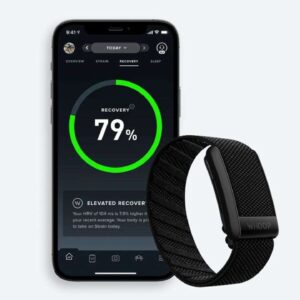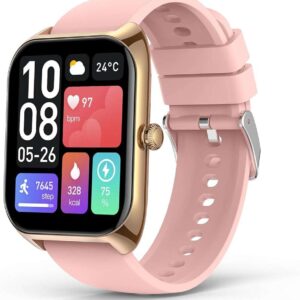


Tired of charging your sleep tracker every night? You’re not alone. Many users look for sleep trackers with long battery life so they can monitor sleep continuously without constant interruptions.
Battery life varies widely. Some smartwatches last just 24 hours, while certain fitness bands and under‑mattress sensors can run for 7, 14, or even 30+ days on a single charge.
The right choice depends on how often you want to charge, how detailed your sleep data needs to be, and whether you prefer a wearable or non‑wearable device.
In this guide, we compare the best sleep trackers with long battery life, highlight real battery performance (not just marketing claims), and break down which models offer the best balance between longevity, accuracy, and price.
If you want to understand how different tracking features impact battery performance, see our complete guide to sleep tracker features.
If you want a quick overview before diving into detailed reviews, here are the longest‑lasting sleep trackers at a glance.
Quick Comparison: Battery Life at a Glance
| Device | Type | Battery Life | Best For | Charging Frequency |
|---|---|---|---|---|
| Garmin Fenix 7 | Smartwatch | Up to 18 days | Heavy users | Weekly+ |
| Amazfit GTR 4 | Smartwatch | Up to 14 days | Balanced use | Weekly |
| Amazfit Band 7 | Fitness Band | 10–18 days | Budget | Bi‑weekly |
| Xiaomi Mi Band 8 | Fitness Band | Up to 16 days | Value seekers | Bi‑weekly |
| Huawei Band 8 | Fitness Band | Up to 14 days | Everyday use | Weekly |
| Withings Sleep Analyzer | Non‑wearable | Plug‑in | Zero charging | None |
Long battery life is not just about convenience. It reduces data gaps and improves long‑term sleep trend accuracy.
If you frequently forget to charge your device or travel often, choosing a tracker that lasts 7 to 14 days or more can significantly improve consistency.
Best Sleep Trackers With Long Battery Life in 2026
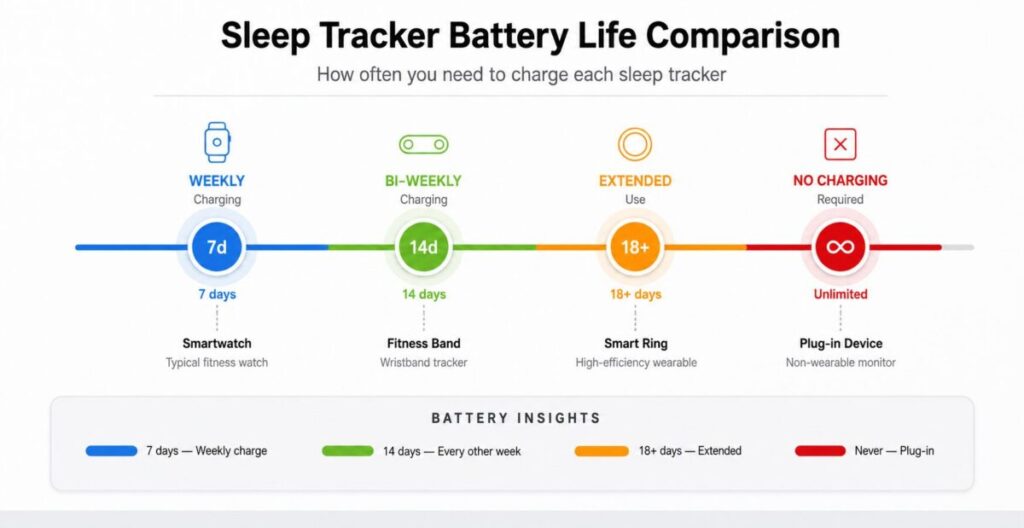
Most long‑lasting sleep trackers fall into three categories: smartwatches, fitness bands, and non‑wearable devices. While some smartwatches require daily charging, the models below can run for 7, 14, or even 18 days on a single charge.
If you are planning extended travel, you may also want to compare these models with our guide to sleep trackers for travel, especially if portability matters as much as battery life.
Below are the top sleep trackers ranked by real‑world battery performance and overall reliability.
🥇 Best Overall Smartwatch: Garmin Fenix 7
Type: Smartwatch
Battery life: Up to 18 days in smartwatch mode
Best for: Maximum battery with advanced sleep and fitness tracking
The Garmin Fenix 7 delivers one of the longest battery lives available in a wearable device. Even with continuous heart rate monitoring and overnight sleep tracking enabled, it comfortably lasts well over a week. In lighter usage modes, battery life extends even further.
For users who want premium features without constant charging, this is the strongest overall option.
For a deeper comparison of overall performance beyond battery life, explore our guide to the best sleep trackers.
🥈 Best Mid‑Range Smartwatch: Amazfit GTR 4
Type: Smartwatch
Battery life: Up to 14 days
Best for: Balanced performance and extended battery
The Amazfit GTR 4 combines sleep tracking, blood oxygen monitoring, and stress tracking while maintaining strong battery efficiency. For more details on how oxygen tracking works and which models support it best, review our guide to sleep trackers with blood oxygen monitoring.
In typical daily use with sleep tracking enabled, most users see between 10 and 14 days per charge.
It offers a practical balance between price and longevity.
🥉 Best Fitness Band for Multi‑Week Battery: Amazfit Band 7
Type: Fitness Band
Battery life: 10 to 18 days depending on usage
Best for: Budget buyers who want extended battery life
Fitness bands often outperform smartwatches in battery longevity. The Amazfit Band 7 can last up to two weeks even with continuous sleep and heart rate tracking active.
If battery life is your main priority, this is one of the strongest value options.
Best Lightweight Ring Option: Oura Ring Gen 3
Type: Smart Ring
Battery life: Up to 7 days
Best for: Discreet and low‑maintenance sleep tracking
The Oura Ring focuses heavily on sleep and recovery metrics. Because it does not use a large display, it conserves power efficiently. Most users can expect close to a full week between charges.
It is ideal for those who prefer minimal bulk while maintaining consistent overnight tracking.
Best Everyday Fitness Band: Huawei Band 8
Type: Fitness Band
Battery life: Up to 14 days
Best for: Reliable weekly charging
The Huawei Band 8 delivers consistent sleep stage tracking and heart rate monitoring while maintaining strong battery performance. With typical usage, it easily lasts beyond a week.
Best Non‑Wearable Option: Withings Sleep Analyzer
Type: Under‑mattress sleep monitor
Battery life: Plug‑in device with no charging required
Best for: Zero charging maintenance
Unlike wearable trackers, the Withings Sleep Analyzer remains plugged in under the mattress. There is no battery to manage. If charging fatigue is your main frustration, a non‑wearable solution may be the most practical choice.
If you prefer not wearing a device at night, compare other non‑wearable sleep trackers here.
Popular but Not Ideal for Long Battery Life
Apple Watch Series 9
Type: Smartwatch
Battery life: Around 18 hours
The Apple Watch provides accurate sleep tracking and advanced health features. However, it requires daily charging and does not qualify as a long battery sleep tracker. It is better suited for users who prioritize smartwatch functionality over extended battery performance.
Why Battery Life Matters in a Sleep Tracker
Battery life does more than reduce charging frequency. It directly affects how consistent and reliable your sleep data becomes over time.
Many smartwatches last only 24 to 36 hours with sleep tracking enabled. That often means daily charging. If you forget to charge your device before bed, you lose an entire night of data. Over weeks, those gaps weaken long‑term sleep trend accuracy.
In contrast, sleep trackers that last 7, 14, or even 18 days allow uninterrupted monitoring. Fewer charging cycles mean fewer missed nights and more stable sleep insights.
Continuous Sleep Data
Sleep tracking only works well when it is consistent. A device that runs for multiple days without charging reduces the risk of skipped nights. This is especially important if you are monitoring recovery, stress patterns, or long‑term sleep improvement.
If maintaining nightly consistency is your goal, you may also want to explore sleep trackers for insomnia that focus on long‑term habit correction.
More Reliable Trend Analysis
Sleep insights become meaningful when viewed across weeks and months. In a clinical setting, sleep stages are measured during a clinical sleep study, while consumer devices estimate stages using movement and heart rate patterns.
Devices that last at least 7 to 14 days per charge reduce tracking gaps and produce more consistent long‑term trends. Fewer missed nights mean more reliable recovery and sleep stability insights.
If improving long‑term sleep consistency is your primary goal, you may also want to explore sleep trackers for insomnia that focus on habit correction and ongoing trend analysis.
Reduced Charging Fatigue
Daily charging creates friction. Over time, that friction reduces usage consistency. Devices with extended battery life are more likely to be worn every night, which improves overall tracking reliability.
Better for Travel and Irregular Schedules
If you travel frequently or work rotating shifts, regular charging may not always be convenient. A device that lasts 10 days or more reduces the risk of missed sleep data during busy periods.
Extended battery life is particularly useful for shift workers who rely on consistent overnight tracking. See our guide to sleep trackers for shift workers for models designed around irregular schedules.
Long Battery Life vs Short Battery Life: What’s the Difference?
Here’s how extended battery models compare to shorter‑lasting devices.
| Feature | Long Battery Life (7–30+ Days) | Short Battery Life (1–2 Days) |
|---|---|---|
| Tracking Consistency | Continuous multi‑day monitoring | Frequent charging gaps |
| Risk of Missed Nights | Low | High |
| Long‑Term Trend Accuracy | Strong | Inconsistent |
| Travel Convenience | Ideal | Limited |
| Charging Frequency | Weekly or bi‑weekly | Daily |
Short‑battery devices often compensate with more smartwatch features, but if sleep tracking is your primary goal, longer battery life usually delivers more consistent results.
Real‑World Battery Performance
Manufacturer battery estimates are based on moderate usage. In real‑world conditions, enabling features such as continuous SpO2 tracking, always‑on display, or frequent notifications can reduce battery life by 10 to 30 percent.
For example, a device rated for 14 days may realistically deliver between 10 and 14 days depending on settings and usage patterns.
What to Look for in a Long Battery Sleep Tracker
Battery life alone does not guarantee a good experience. The goal is to balance extended battery performance with reliable sleep tracking accuracy.
Here are the factors that actually matter when choosing a long‑battery sleep tracker.
How Much Battery Life Is Enough?
For most users, 7 days is the practical minimum for weekly charging. Devices that last 10 to 14 days provide greater flexibility, especially for travel or irregular schedules. Models rated for 18 days or more are ideal for those who prefer minimal maintenance. Plug‑in sleep trackers eliminate charging concerns entirely.
Keep in mind that enabling features such as continuous SpO2 tracking, always‑on display, or frequent notifications may reduce real‑world battery performance compared to manufacturer estimates.
Features That Impact Battery Drain
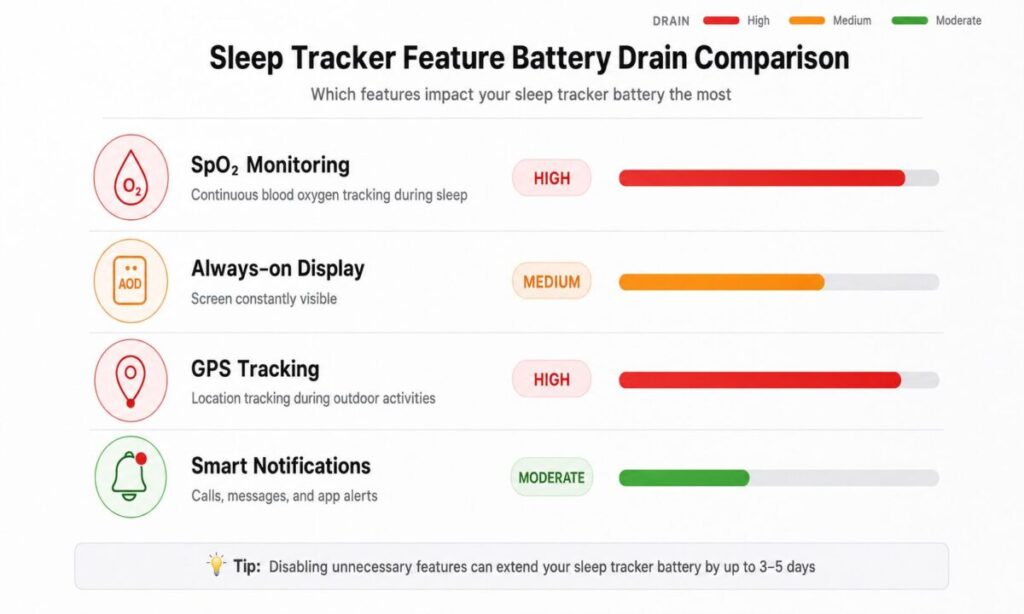
Not all features consume power equally. If long battery life is your priority, pay attention to how these functions affect daily usage:
- Continuous heart rate monitoring
- Blood oxygen tracking during sleep
- Always‑on display
- GPS tracking
- Frequent app syncing
If you plan to use advanced health metrics every night, expect battery life to shorten slightly compared to manufacturer claims.
Which Features Are Worth It?
While battery life is the focus, certain features genuinely improve sleep insights without drastically reducing performance:
- Sleep stage tracking
- Smart alarms for light‑sleep wake‑ups
- Weekly sleep trend reports
- Stress and recovery metrics
The key is choosing a tracker that delivers meaningful insights without requiring daily charging.
If extended battery life is your top priority, prioritize efficiency over unnecessary smartwatch extras.
Best Budget Sleep Trackers With Long Battery Life
Long battery life does not require a premium price. Several affordable fitness bands deliver 10 to 18 days of battery performance while still providing reliable overnight sleep tracking.
If your goal is extended battery life without paying for advanced smartwatch features, these models offer strong value.
Top Budget Picks for Battery Performance
- Xiaomi Mi Band 8 – Up to 16 days of battery life
- Amazfit Band 7 – 10 to 18 days depending on usage
- Huawei Band 8 – Up to 14 days of typical use
- Fitbit Inspire 3 – Around 10 days per charge
- Letsfit ID205L – Up to 10 days with standard tracking enabled
These devices prioritize efficiency over power‑intensive smartwatch functions, which helps extend battery duration.
Budget Battery Comparison
| Device | Battery Life | Approx. Price | Best For |
|---|---|---|---|
| Xiaomi Mi Band 8 | Up to 16 days | ~$40 | Value seekers |
| Amazfit Band 7 | 10–18 days | ~$50 | Long battery under $50 |
| Huawei Band 8 | Up to 14 days | ~$45 | Everyday tracking |
| Letsfit ID205L | ~10 days | ~$30 | Lowest price |
Battery life may decrease if continuous SpO2 tracking or always‑on display is enabled. However, even with standard overnight tracking active, these models comfortably exceed one week of use.
Budget devices often lack premium smartwatch features such as advanced GPS or high‑resolution displays. The trade‑off is improved battery efficiency, which benefits users focused primarily on sleep tracking rather than smartwatch functionality.
How to Extend the Battery Life of Your Sleep Tracker
Long battery life depends not only on device design but also on how you use and maintain it. Small adjustments can help you get closer to the manufacturer’s advertised battery range.
Here are practical steps to reduce battery drain and maintain long‑term performance.
Adjust Power‑Intensive Features
Some features consume more battery than others. If extended battery life is your priority, consider adjusting:
- Continuous SpO2 monitoring
- Always‑on display
- Frequent background syncing
- GPS tracking
- High screen brightness
Disabling or limiting these features can significantly extend daily battery performance.
Charge Strategically
Modern devices use lithium batteries, and maintaining proper lithium-ion battery health can improve long‑term performance.
- Avoid leaving the device plugged in overnight every day
- Do not let the battery regularly drop to 0%
- Use the manufacturer’s recommended charger
Occasional full charges are fine, but consistent overcharging can shorten long‑term battery health.
Keep Software Updated
Manufacturers frequently release firmware updates that improve battery efficiency.
Updates may include:
- Background process optimization
- Bug fixes that reduce battery drain
- Improved power management settings
Keeping your device updated ensures you benefit from these improvements.
Manage Notifications and Background Apps
If your sleep tracker functions as a smartwatch, notifications and constant app syncing can drain the battery quickly.
Reducing non‑essential notifications can noticeably increase battery duration, especially on devices rated for 7 to 14 days.
Battery life is partly hardware, partly usage behavior. Even devices rated for 14 days may last longer or shorter depending on how aggressively features are used.
Frequently Asked Questions
How long does a sleep tracker battery last?
Most sleep trackers last between 7 and 14 days on a single charge. Premium models may reach 18 days or more, while some smartwatches require daily charging. Real‑world battery life depends on features such as SpO2 monitoring and display settings.
Do sleep tracking features drain battery faster?
Yes. Continuous heart rate monitoring, overnight SpO2 tracking, always‑on display, and frequent notifications can reduce battery life by 10 to 30 percent compared to manufacturer estimates.
Is 7 days of battery life enough for sleep tracking?
For most users, 7 days is sufficient because it allows weekly charging. However, if you travel often or prefer minimal maintenance, devices offering 10 to 14 days provide greater flexibility.
Are fitness bands better than smartwatches for battery life?
In most cases, yes. Fitness bands use simpler displays and fewer background processes, which allows them to last longer than full smartwatches with similar sleep tracking features.
Do non‑wearable sleep trackers need charging?
Most under‑mattress sleep trackers remain plugged in and do not require charging. This eliminates battery concerns and allows uninterrupted sleep monitoring.
Can charging habits affect long‑term battery health?
Yes. Frequently draining the battery to zero or keeping the device plugged in continuously may reduce long‑term battery performance. Keeping the charge between roughly 20 and 80 percent can help maintain battery health.
Conclusion
Battery life is more than a convenience feature. It directly affects how consistent and reliable your sleep tracking becomes over time.
Devices that last at least 7 days reduce charging interruptions and minimize missed nights. Models offering 10 to 18 days provide even greater flexibility, especially for travel or busy schedules. If charging fatigue has been your biggest frustration, choosing a long‑lasting tracker can make a noticeable difference.
The right device depends on your priorities. Some users prefer advanced smartwatch features with weekly charging. Others want multi‑week battery life with minimal maintenance. Non‑wearable options remove charging concerns entirely.
Focus on the battery range that fits your routine, and you will get more consistent sleep data with less effort.

A passionate tech blogger and the founder of Best Tech View, a dynamic platform dedicated to all things technology. With a keen interest in the tech, Ahmad strives to provide insightful and engaging content on the latest tech trends, and breakthroughs.