


Sleep trackers with environmental monitoring focus on something most people overlook.
When sleep falls apart, we blame stress, caffeine, bad routines, or late night scrolling. Those factors matter. But the bedroom itself often plays an equal or bigger role.
A room that runs too warm can reduce deep sleep. Background noise can trigger micro awakenings you never remember. Even low levels of light can suppress melatonin and shift your circadian rhythm.
Here’s what matters.
People adapt to poor sleep conditions slowly. You get used to the hum of a fan, street traffic, or a warm room. Because the change is gradual, the disruption becomes invisible.
That is where environmental monitoring comes in.
Modern sleep trackers now measure:
- Room temperature
- Noise levels
- Snoring patterns
- Sleep related sounds
- Light exposure
The promise is straightforward. Track your environment, spot hidden disruptions, and improve sleep.
But here’s the reality. More data does not automatically mean better rest.
This guide explains what environmental monitoring in sleep trackers actually measures, which features provide real value, and where the technology still falls short.
How Your Sleep Environment Affects Sleep
Why Your Sleep Environment Matters More Than You Think
People underestimate how sensitive sleep is to the room around them.
Your brain does not switch off at night. Even during deeper stages, it continues scanning for sound, light, and temperature changes. That means small disruptions can reduce sleep quality without fully waking you.
Here’s what most people miss.
You judge sleep based on memory. If you do not remember waking up, you assume you slept well. But sleep can fragment without leaving a clear memory behind.
Let’s break down the main environmental factors.
Noise and Sleep Disruption
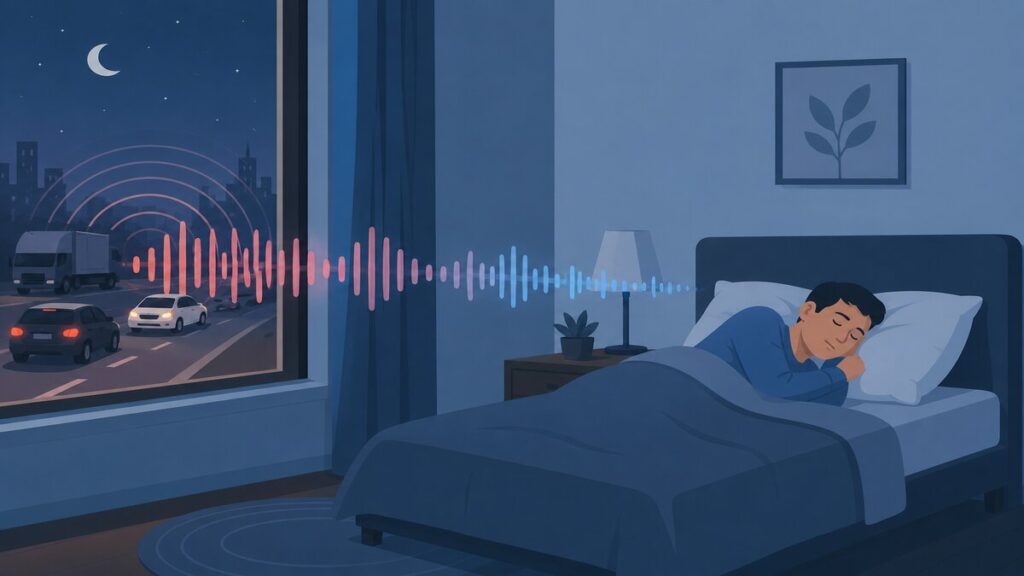
Noise affects sleep in two ways:
- Direct awakenings
- Subtle sleep fragmentation
The first is obvious. A loud sound wakes you up.
The second is harder to detect. Traffic, hallway movement, televisions, or barking dogs may not fully wake you, but they can reduce sleep depth and recovery.
Research shows unpredictable noise is especially disruptive. Studies on environmental noise and sleep disturbance show that irregular and unpredictable sounds are more likely to fragment sleep than steady background noise.
The brain treats irregular sounds as potentially important. A steady fan is often less harmful than random street noise for this reason.
Keep this in mind: sleeping through the night does not automatically mean sleeping well.
Temperature and Sleep Quality
Temperature plays a direct role in sleep depth.
Your body naturally lowers its core temperature as part of the sleep process. A room that is too warm interferes with that cooling cycle.
Common results include:
- Restlessness
- More frequent awakenings
- Reduced deep sleep
- Night sweating
- Lighter overall sleep
Many people equate comfort with warmth. For sleep, that assumption is often wrong.
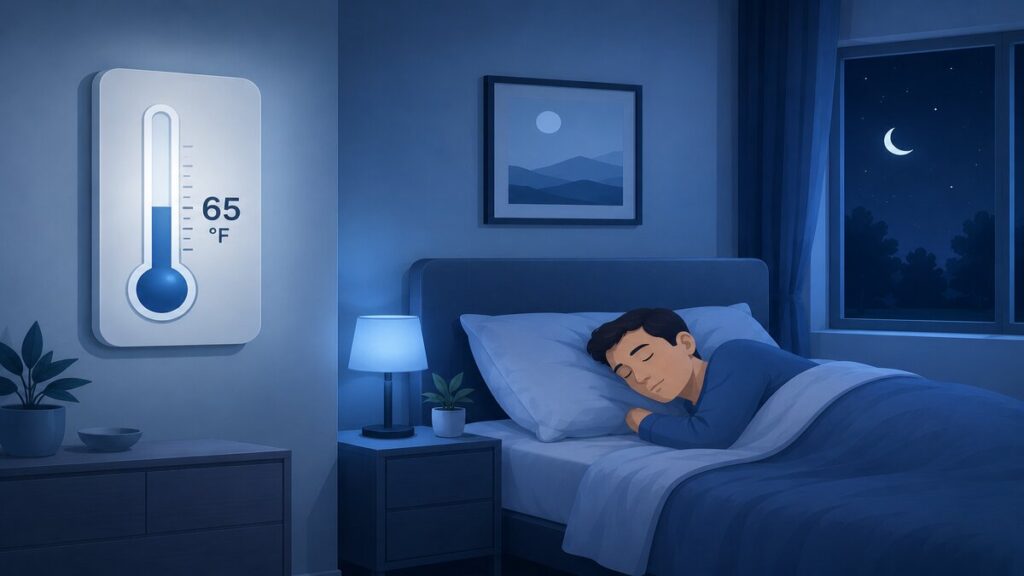
Most research suggests a slightly cooler room supports better sleep for many adults, often in the range of 60 to 67 degrees Fahrenheit. Individual preference matters, but excessively warm bedrooms consistently show negative effects on sleep quality.
Light Exposure and Circadian Rhythm
Light directly regulates circadian rhythm. This is biology, not a trend.
Your brain uses light exposure to control melatonin production and sleep timing. Even small amounts of artificial light at night can interfere with this system.
Common sources include:
- Streetlights through windows
- Phone screens before bed
- Bright indoor lighting
- Televisions left on
- Inconsistent morning light exposure
Many people focus only on blue light. That is an oversimplification. Brightness itself matters. A very bright warm colored bulb can still delay sleep signals.
If your goal is to improve sleep timing and consistency, environmental light exposure deserves as much attention as screen settings.
The Everyday Problems People Ignore
Most sleep disruptions are ordinary:
- Traffic noise in apartments
- Warm rooms with poor airflow
- Late night screen use
- Partners with different sleep preferences
- Pets jumping on the bed
- Bright electronic indicators
- Inconsistent bedtime environments
None of these seem dramatic on their own. But sleep is cumulative. Small disruptions repeated nightly add up.
Here’s the key distinction.
Behavior matters. Habits matter. But habits always exist inside an environment. Someone can follow solid routines and still sleep poorly in a noisy, warm, or bright bedroom.
At the same time, environmental optimization is not magic. No device can compensate for chronic sleep deprivation, irregular schedules, or excessive caffeine.
Technology can support awareness. It cannot replace fundamentals.
If you want to focus specifically on habit driven improvements, see our guide on sleep trackers for sleep quality.
That distinction becomes important when evaluating environmental monitoring features.
What Environmental Monitoring in Sleep Trackers Actually Measures
Environmental monitoring sounds technical and precise.
Sometimes it is. Sometimes it relies on estimation layered onto consumer hardware. That difference matters, and most product pages gloss over it.
Let’s break it down clearly.
How Sleep Trackers Collect Environmental Data
Modern sleep trackers use a mix of sensors and signal processing, including:
- Microphones
- Temperature sensors
- Ambient light sensors
- Motion sensors
- Heart rate sensors
- Algorithm based pattern recognition
Some devices gather data directly from the wearable. Others rely on a smartphone microphone or a bedside unit.
Placement changes everything.
A smartwatch on your wrist cannot capture room noise the same way a bedside monitor can. Skin temperature is not the same as room temperature. Light exposure at eye level differs from light hitting your wrist.
These are not minor details. They directly affect accuracy.
Marketing often compresses these differences into a simple feature list. That can create unrealistic expectations.
Estimation Versus Direct Measurement
This is where confusion usually starts.
Many environmental features estimate conditions instead of measuring them directly.
For example:
- A wearable may infer sleep disturbance from movement combined with sudden audio spikes.
- Temperature tracking may reflect skin temperature trends rather than the actual room temperature.
- Snoring detection may rely on pattern recognition from nearby audio, not medical grade respiratory sensors.
Those are meaningful differences.
Estimation is not useless. But it is not the same as controlled laboratory measurement.
Consumer sleep trackers are wellness tools. They are designed for pattern awareness, not clinical diagnosis.
If you want a deeper explanation of how these estimates connect to sleep stage data, see our guide on sleep tracker sleep analysis.
Why Environmental Monitoring Still Has Value
Here’s the key point.
Imperfect data can still be useful if it consistently reveals patterns.
If your tracker shows fragmented sleep on nights with higher recorded noise levels, that pattern may push you to test changes such as:
- Adding white noise
- Improving window insulation
- Adjusting your sleep schedule
- Rearranging your bedroom setup
The device does not need perfect precision. It needs repeatable signals that influence behavior.
That distinction matters when evaluating sleep trackers with environmental monitoring. The goal is not laboratory accuracy. The goal is actionable awareness.
If you want to focus specifically on turning sleep data into habit changes, see our guide on sleep trackers for sleep quality.
Core Environmental Features Explained
Not all environmental features deliver equal value. Some reveal patterns you can act on. Others sound impressive but add little clarity.
Let’s examine them one by one.
Audio and Noise Monitoring
Audio monitoring is common in sleep trackers with environmental monitoring. In most cases, it works through a smartphone microphone or a bedside device rather than the wearable itself.
What It Records
Depending on the system, audio tracking may detect:
- Snoring
- Sleep talking
- Sudden loud noises
- Movement related sounds
- Coughing
- General environmental disturbances
Some apps generate overnight sound timelines to show when disruptions occurred.
That sounds sophisticated. Accuracy depends heavily on microphone placement and software quality.
Where It Helps
Audio tracking can uncover patterns people miss, such as:
- Frequent snoring
- Noisy HVAC systems
- Traffic spikes during certain hours
- Pets jumping on the bed
- Repeated coughing episodes
Many users are unaware of what happens overnight. Seeing patterns can prompt simple fixes.
Where It Falls Short
Microphones struggle to distinguish sound sources reliably.
- A partner’s snoring may be attributed to you.
- Outdoor traffic may trigger disturbance markers.
- A television left on may confuse detection systems.
Audio data should be treated as a signal, not a precise measurement.
There is also a privacy factor. Overnight recording involves sensitive data. Before enabling it, review where recordings are stored, whether they are uploaded to the cloud, and how long they are retained.
Audio monitoring can be useful. It requires realistic expectations.
Snoring Detection
Snoring detection is heavily marketed. Sometimes it provides helpful awareness. Sometimes it creates unnecessary concern.
How It Works
Most systems rely on microphones combined with pattern recognition algorithms. Some pair audio with breathing trends or motion data to improve detection.
It is important to remember this is pattern matching, not medical evaluation.
When It Matters
Frequent snoring can signal disrupted sleep or breathing irregularities. It does not automatically indicate a medical condition.
Patterns may deserve attention when combined with:
- Daytime fatigue
- Morning headaches
- Gasping during sleep
- Poor recovery
- Excessive daytime sleepiness
Here’s the boundary.
A sleep tracker can highlight trends. It cannot diagnose sleep apnea or other disorders. For broader insight into how wearables track breathing and recovery metrics, see our guide on sleep trackers for health monitoring.
If patterns look concerning, the next step is medical evaluation, not more app data.
Accuracy Limits
Common false positives include:
- Fans
- Television audio
- Outdoor noise
- A partner’s snoring
Snoring data is directional. Long term patterns matter more than isolated events.
Sleep Sound Analysis
Some systems go beyond basic noise detection and attempt deeper sound classification.
Pattern Recognition
Advanced apps may try to categorize:
- Snoring intensity
- Breathing irregularities
- Repeated disturbances
- Environmental interruptions
The concept is logical. Execution varies widely.
Noise Versus Real Disruption
Not all sound affects sleep equally.
A steady fan may improve sleep for one person. Sudden unpredictable sounds are typically more disruptive because the brain treats them as potential threats.
Many consumer apps oversimplify this distinction and treat all sound spikes as equally important.
That can inflate perceived problems.
Practical Value
The primary benefit is awareness. People often underestimate how noisy their bedroom is.
Still, not every detected sound equals a meaningful disruption. Sound analysis works best as a directional tool, not a definitive measurement system.
Temperature Monitoring
Temperature tracking has gained popularity for good reason. Compared to many flashy features, it often connects directly to sleep quality.
Room Temperature Versus Skin Temperature
This distinction is critical.
Some devices measure ambient room temperature. Others track changes in skin temperature at the wrist or finger.
These are not interchangeable.
Skin temperature trends can reflect physiological changes, but they do not always mirror actual bedroom conditions. Confusing the two leads to unrealistic expectations.
How Temperature Influences Sleep
Temperature affects:
- Sleep onset
- Deep sleep stability
- Restlessness
- Night awakenings
- Overall comfort
Your body lowers its core temperature during the night. A warm room interferes with that process.
Most adults sleep better in slightly cooler rooms, often between 60 and 67 degrees Fahrenheit. Research cited by the National Sleep Foundation supports keeping bedroom temperatures in a slightly cooler range to promote deeper and more stable sleep.
Individual preference varies, but excessively warm environments consistently disrupt sleep depth.
Real World Value
Temperature tracking becomes useful when it drives change.
For example:
- Adjusting the thermostat
- Improving airflow
- Switching bedding
- Enhancing ventilation
The tracker is not the solution. The environmental adjustment is.
Light and UV Monitoring
Light tracking is one of the more biologically grounded features.
Circadian Rhythm Connection
Light is the brain’s primary timing signal.
Morning exposure supports alertness and circadian alignment. Bright light at night delays melatonin production and shifts sleep timing.
Tracking light patterns can help identify inconsistent exposure.
When It Helps
Light monitoring is especially relevant for:
- Shift workers
- People who use screens late at night
- Those with irregular schedules
- Individuals sleeping during daytime hours
- Seasonal sleep pattern shifts
For these groups, light data may reveal actionable patterns.
Where It Falls Short
For many users, the issue is already obvious.
If someone spends hours on a bright screen before bed, a tracker confirming high light exposure adds little insight.
This is where technology sometimes measures what people already know but have not changed.
UV monitoring, in particular, rarely influences nighttime sleep behavior in a meaningful way for most adults.
Practical Takeaway
Light tracking reinforces awareness. It does not replace discipline.
Used thoughtfully, it supports better timing habits. Used passively, it becomes another unused metric.
Which Environmental Features Actually Matter
This is where clarity matters.
Not every feature inside sleep trackers with environmental monitoring delivers real world value. Some reveal patterns you can fix. Others generate impressive looking charts that rarely change behavior.
Here is a practical way to think about it.
Environmental Features Ranked by Real World Impact
| Feature | Real World Value | Why It Matters | Actionability |
|---|---|---|---|
| Temperature Tracking | High | Directly affects sleep depth and comfort | High |
| Noise Monitoring | High | Identifies hidden disruptions and fragmentation | High |
| Snoring Detection | Medium to High | Builds long term pattern awareness | Medium |
| Light Monitoring | Medium | Supports circadian timing adjustments | Medium |
| Advanced Sound Classification | Medium | Adds detail, accuracy varies | Low to Medium |
| UV Monitoring | Low | Rarely influences nighttime sleep behavior | Low |
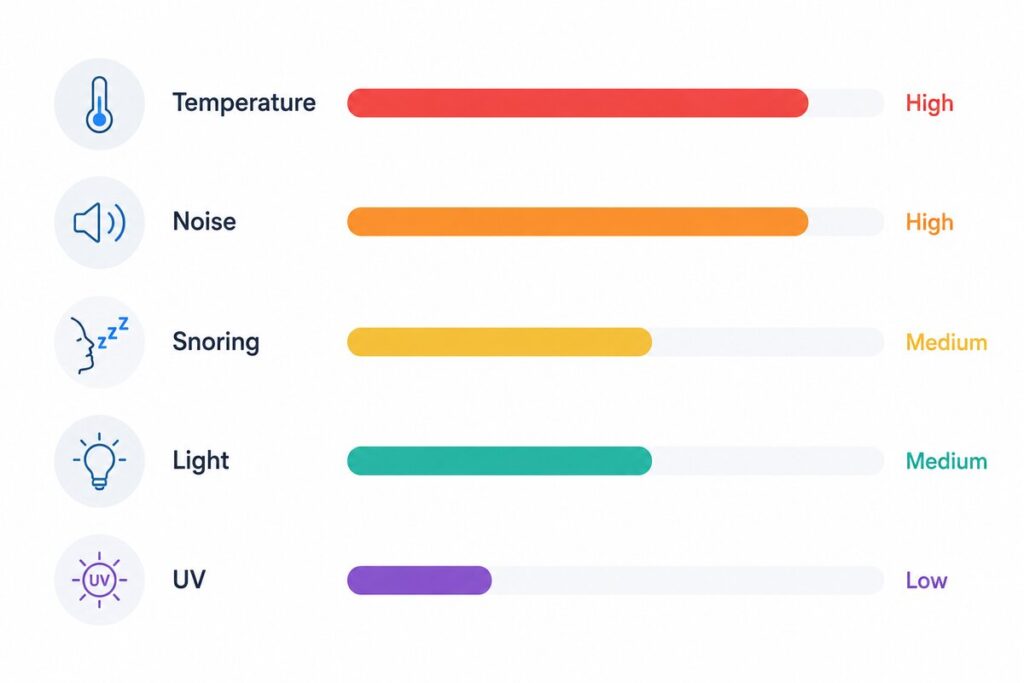
Now let’s interpret what this actually means.
The Features That Consistently Deliver
Temperature and noise monitoring usually provide the clearest return.
Why?
Because they connect directly to variables you can control. You can lower the thermostat and improve airflow. You can add white noise or adjust your bedroom layout.
The cause and effect relationship is visible.
If warmer nights consistently align with lighter sleep, you have a clear experiment to run. If noise spikes match restless periods, you can test sound masking or insulation changes.
That feedback loop is practical. That is real value.
The Features That Sound More Advanced Than They Are
Snoring detection and detailed sound classification can be useful, especially for long term pattern awareness. But their usefulness depends on consistency.
If detection accuracy fluctuates, interpretation becomes difficult. A single alert means very little. Trends over weeks matter more.
Light monitoring sits in the middle. It is biologically grounded and important for circadian rhythm. But in many cases the issue is already obvious. If someone uses a bright phone in bed every night, confirmation does not equal correction.
UV monitoring rarely changes sleep behavior for most adults. It adds data, but seldom drives meaningful improvement.
More complexity does not automatically mean more benefit.
A Smarter Way to Evaluate Features
Before you get impressed by a long feature list, ask three direct questions:
- Can I realistically change this factor?
- Will this data remain consistent enough to reveal patterns?
- If this metric shifts, do I know exactly what action to take?
If the answer is no, the feature probably has limited practical impact.
Room temperature checks all three boxes. Advanced sound labeling often does not.
Detail without clarity creates noise of its own.
Avoid the Feature Count Trap
Many devices compete by stacking more sensors and more categories. The marketing message is simple: more data equals better sleep.
That assumption falls apart under scrutiny.
A short list of reliable, actionable measurements often beats a long list of loosely interpreted signals. Precision and usability matter more than feature count.
Environmental monitoring should support decisions, not create dependency. If you feel overwhelmed by charts but unsure what to change, the system is not helping.
The key point
The best environmental features are the ones that make your next adjustment obvious.
Temperature and noise tracking consistently offer the highest leverage for most people.
Snoring and light monitoring can add context.
Highly granular sound breakdowns and UV metrics often add detail without proportionate impact.
Useful sleep tracking increases actionable awareness. If a feature does not influence a decision in your bedroom, it is just another number.
When Environmental Tracking Helps and When It Doesn’t
Environmental monitoring is not equally useful for everyone.
For some people, it reveals clear patterns and supports meaningful change. For others, it adds extra data without improving sleep.
Understanding that difference prevents unrealistic expectations.
Irregular Sleepers
People with inconsistent schedules often benefit the most.
Irregular bedtimes usually come with irregular environments. Late night noise, shifting room temperatures, and inconsistent light exposure tend to follow unstable routines.
Tracking helps surface those patterns.
If disrupted nights cluster around specific conditions, that insight can guide small but targeted adjustments.
For irregular sleepers, environmental data often highlights instability they did not fully recognize.
Light Sleepers
Light sleepers experience disruptions more intensely, even if they do not remember waking up.
For them, noise monitoring and sound tracking can confirm repeat disturbances.
That awareness may support practical adjustments such as:
- Adding white noise
- Using earplugs
- Rearranging the bedroom layout
- Improving window insulation
- Managing pets at night
In these cases, environmental tracking reinforces lived experience and provides clearer direction.
Noise Sensitive Individuals
Some people are especially reactive to unpredictable sound.
Tracking can validate patterns they already suspect. That validation matters. When sleep feels poor despite spending enough time in bed, uncertainty creates frustration.
If data consistently shows noise spikes aligning with restless periods, the problem becomes specific instead of vague.
Specific problems are easier to solve.
Who May Not Benefit Much
Here is the counterpoint.
Not everyone needs detailed environmental monitoring.
People who already sleep well, fall asleep easily, and wake rested most days are unlikely to gain much from granular overnight analytics.
This is rarely emphasized in marketing. Continuous optimization sounds compelling. But optimization only makes sense when there is a clear problem to address.
Adding more metrics to an already stable routine often creates distraction rather than improvement.
The Bigger Picture
Environmental tracking is most helpful when there is uncertainty about why sleep feels inconsistent.
It is less helpful when sleep is already stable or when the root issue is clearly behavioral, such as chronic sleep deprivation or heavy late night caffeine use.
Technology can clarify patterns. It cannot compensate for consistently poor habits.
The takeaway: environmental monitoring works best as a troubleshooting tool, not as a universal necessity.
How to Choose a Sleep Tracker for Environmental Monitoring
Not all sleep trackers with environmental monitoring measure the same things. The feature list can look similar on paper, but implementation varies significantly.
Before focusing on brands, start with criteria.
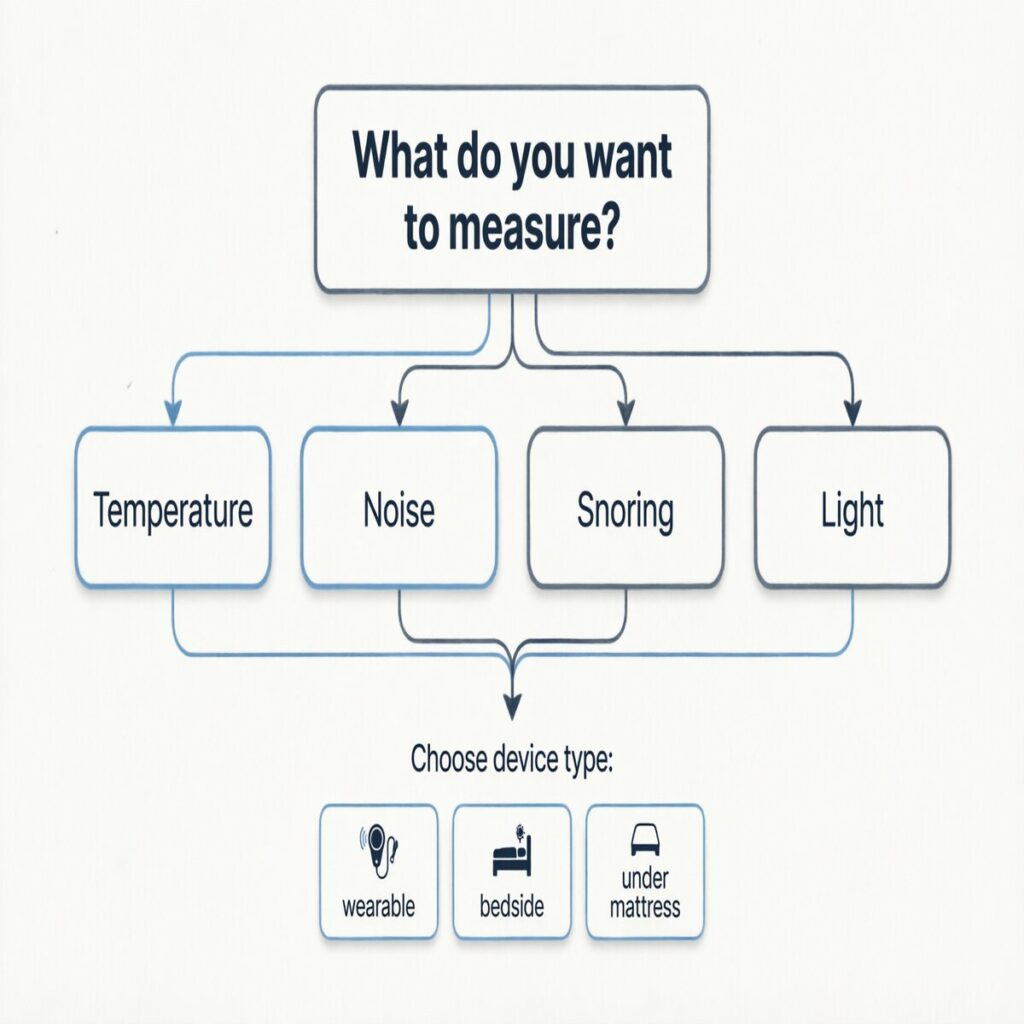
Step 1: Identify What You Actually Want to Measure
Ask yourself:
- Are you trying to reduce room noise?
- Do you want accurate room temperature data?
- Are you curious about snoring patterns?
- Are you focused on circadian light exposure?
Different devices prioritize different sensors. Clarity here prevents overbuying.
Step 2: Understand Sensor Placement
Placement affects accuracy.
- Wrist wearables may estimate temperature from skin trends.
- Bedside devices often capture room noise more accurately.
- Under mattress systems avoid wearable discomfort but lack mobility.
If environmental noise is your main concern, microphone placement matters more than app design.
Step 3: Evaluate Actionability
A useful environmental tracker should make the next step obvious.
If the app shows higher room temperature during fragmented sleep, you should be able to adjust your thermostat. When noise spikes appear nightly, your setup should allow practical changes.
If the data does not clearly point toward an adjustment, its practical value declines.
Step 4: Consider Comfort and Friction
Environmental monitoring only helps if you use the device consistently.
- Some people dislike wearing watches overnight.
- Others prefer rings.
- Some want fully passive, under mattress systems.
Low friction often matters more than advanced features.
Examples of Devices with Environmental Monitoring
Different devices approach this category differently:
- Fitbit models combine wearable sleep scoring with basic snoring detection.
- Withings Sleep Analyzer focuses on under mattress monitoring and bedroom data collection.
- Oura Ring emphasizes temperature trends and recovery signals in a low profile format.
- Garmin devices integrate sleep data with broader fitness recovery metrics.
Each reflects a different philosophy. None are universally best. The right choice depends on which environmental factors matter most to you.
If you want a broader comparison of leading models across all categories, see our complete guide to the best sleep trackers.
Bottom Line
Choose sensors first. Choose brands second.
The best sleep tracker for environmental monitoring is the one that measures the factors you can actually change and does so in a format you will consistently use.
Common Mistakes to Avoid with Environmental Sleep Tracking
Many frustrations with sleep trackers do not come from the technology itself. They come from unrealistic expectations.
Environmental monitoring can increase awareness. It cannot fix everything.
Here are the most common mistakes.
Over Relying on Data
Data is useful. Obsessing over it is not.
Some people treat sleep trackers as objective truth machines. They are not. Consumer devices estimate patterns using imperfect sensors and algorithms.
Small inaccuracies are normal. A single odd night does not mean something is wrong.
If you check your sleep app before checking how you actually feel, the tool may be driving your perception instead of informing it.
Patterns over time matter. Individual nights rarely tell the full story.
Ignoring Basic Sleep Habits
No amount of environmental tracking compensates for chronic sleep restriction.
If someone consistently sleeps five hours per night, the issue is not advanced analytics. The issue is insufficient time in bed.
Environmental optimization makes sense when the fundamentals are solid:
- Consistent schedule
- Adequate sleep duration
- Moderate caffeine use
- Reasonable screen exposure
Technology can support good habits. It cannot replace them.
Expecting Medical Precision
This is a frequent misunderstanding.
Snoring detection, breathing trend analysis, and sound classification do not function like clinical sleep studies.
Sleep trackers can highlight patterns and possible concerns. They cannot diagnose sleep apnea or other disorders.
If data suggests a potential issue, the next step is professional evaluation, not deeper app analysis.
Treat consumer devices as awareness tools, not medical instruments.
Ignoring Privacy Considerations
Audio monitoring deserves serious thought.
Many people enable overnight microphones without reviewing:
- Where recordings are stored
- Whether audio clips are uploaded to the cloud
- How long data is retained
- Whether recordings can be permanently deleted
- Who has access to that data
Your bedroom is one of the most private environments in your life. Devices that capture overnight sound require informed consent, not casual activation.
Chasing Perfect Sleep Scores
Another subtle mistake is trying to optimize every metric to perfection.
Sleep naturally varies from night to night. Travel, stress, illness, and schedule shifts all influence results.
If you constantly chase a higher score, you risk turning sleep into a performance task instead of a recovery process.
The goal is better consistency, not perfection.
What this means
Environmental sleep tracking works best when used as a guide, not a judge.
Use the data to spot patterns. Make small adjustments. Then step back and evaluate how you actually feel.
Awareness should reduce stress, not create it.
How to Improve Your Sleep Environment Without Buying Anything
Before you invest in sleep trackers with environmental monitoring, test the fundamentals.
Most bedroom problems can be improved with simple adjustments. No sensors required.
Here’s where to start.
Adjust Temperature First
Temperature is one of the highest leverage variables in sleep quality.
Try lowering your bedroom temperature slightly for a week. Many adults sleep best in a range of about 60 to 67 degrees Fahrenheit.
If adjusting the thermostat is not possible:
- Use lighter bedding
- Improve airflow with a fan
- Open windows when weather allows
- Switch to more breathable sheets
Track how you feel, not just how long you sleep.
If sleep becomes deeper and less restless, you have confirmed a real environmental factor.
Control Noise Strategically
Not all sound is harmful. Unpredictable sound is.
If you live in a noisy area, test:
- Consistent white noise
- Earplugs designed for sleep
- Rearranging the bed away from shared walls
- Sealing small gaps around windows
Run each change for several nights before judging results. Sleep responds to patterns, not single night experiments.
Reduce Light Exposure at Night
Dim your bedroom lights at least 30 to 60 minutes before bed.
Other small adjustments:
- Block light leaks from windows
- Cover bright electronic indicators
- Avoid overhead lighting late at night
- Keep your phone out of direct line of sight
Morning light matters too. Exposure to natural light shortly after waking helps stabilize circadian rhythm.
These shifts cost nothing and often produce noticeable improvements.
Stabilize the Environment
Consistency matters more than perfection.
Try to keep:
- Bedtime lighting consistent
- Maintain a stable room temperature
- Reduce variability in noise conditions
- Follow regular sleep and wake times
An unpredictable environment creates subtle stress signals the brain continues monitoring overnight.
Stability reduces that load.
Use Simple Tracking Before Buying Technology
If you are unsure whether your environment is the issue, run a low tech experiment.
For one to two weeks:
- Note bedtime and wake time
- Record perceived room temperature
- Write down noticeable noise events
- Rate how rested you feel each morning
Patterns often emerge quickly.
If you still feel uncertain after structured testing, then environmental monitoring technology may add clarity.
Why This Matters
Devices can increase awareness. They cannot replace basic experimentation.
Improving sleep often starts with small, consistent environmental changes. Technology works best when it supports decisions you are already prepared to make.
Start simple. Measure only when necessary.
Frequently Asked Questions
Are sleep tracker noise measurements accurate?
They are generally moderately accurate, not precise.
Most devices can detect overall noise levels and spikes during the night. Identifying the exact source of a sound is much harder. A partner’s snoring, outside traffic, or a television may be grouped under the same disturbance marker.
Use noise data to spot patterns over time, not to label specific events with certainty.
Can sleep trackers reliably detect snoring?
They can detect probable snoring patterns, but false positives are common.
Microphones rely on pattern recognition. Environmental sounds and partner noise can confuse the system. Accuracy improves when the device is placed close to the sleeper, but it still is not clinical grade.
Look for consistent trends across weeks rather than reacting to a single night.
Does room temperature really affect sleep quality?
Yes.
Temperature directly influences sleep onset, depth, and nighttime awakenings. Your body lowers its core temperature at night. A warm room can interfere with that process.
Many adults sleep better in slightly cooler environments, often between 60 and 67 degrees Fahrenheit. Individual comfort varies, but excessive warmth consistently disrupts sleep stability.
Is audio monitoring worth using?
For some people, yes.
Audio tracking can reveal disturbances you never consciously notice, such as repeated coughing, traffic spikes, or persistent snoring.
That said, privacy matters. Before enabling overnight recording, review storage policies, cloud uploads, and data retention settings. Awareness should not come at the cost of careless data exposure.
Are environmental sleep features medically reliable?
No.
These features support awareness and habit improvement. They do not replace medical testing or professional evaluation.
If snoring, breathing irregularities, or extreme fatigue raise concern, consult a qualified healthcare provider. Consumer devices are not diagnostic tools.
Which environmental feature matters most?
For most people, the highest leverage features are:
- Temperature tracking
- Noise monitoring
- Basic snoring awareness
These tend to connect directly to adjustments you can make in your bedroom. The most valuable feature is the one that clearly guides your next action.
Final Verdict: Are Sleep Trackers with Environmental Monitoring Worth It?
Environmental sleep tracking is useful when it increases awareness without creating obsession.
That balance matters.
Some features genuinely help uncover hidden problems. Others mostly add layers of data without changing behavior. The difference comes down to actionability.
A slightly cooler room may improve deep sleep more than any advanced analytics dashboard. Reducing unpredictable nighttime noise may have a bigger impact than detailed AI driven sleep scores.
Simple environmental adjustments often outperform complicated optimization systems.
That reality is not emphasized enough.
Sleep trackers with environmental monitoring do not create better sleep on their own. They highlight patterns and reduce guesswork. They make it easier to test changes.
The improvement still comes from what you adjust in your bedroom and in your routine.
If you are willing to act on what you learn, environmental tracking can be a practical tool.
If you are looking for a device to fix sleep without changing anything, it will disappoint.
The technology supports better sleep. It does not replace the work required to achieve it.

A passionate tech blogger and the founder of Best Tech View, a dynamic platform dedicated to all things technology. With a keen interest in the tech, Ahmad strives to provide insightful and engaging content on the latest tech trends, and breakthroughs.
