


Sleep tracker features can look impressive on a product page. Heart rate monitoring. Blood oxygen tracking. REM detection. Smart alarms. AI coaching. The list keeps growing.
But here’s what matters: not every sleep tracker feature improves your sleep, and more sensors do not automatically mean better results.
Most people buy based on claims. They see advanced metrics and assume accuracy. They see more data and assume insight. That logic doesn’t always hold. A runner might benefit from recovery metrics and heart rate variability tracking. Someone struggling with insomnia may care more about smart alarms and guided breathing. A light sleeper sharing a bed might prioritize vibration alerts over everything else.
Let me explain what we’re going to do here. We’ll break down the most important sleep tracker features, how they actually work, where they fall short, and who truly needs them. No hype. No marketing language. Just clarity.
Bottom line: when you understand the features, you stop buying based on buzzwords and start choosing based on your real sleep problem.
Sleep trackers are wellness devices, not medical diagnostic tools. Keep that in mind as we go deeper.
Core Health Sensors in Modern Sleep Trackers
Most sleep tracker features start with sensors. If the sensors are weak, everything built on top of them is guesswork.
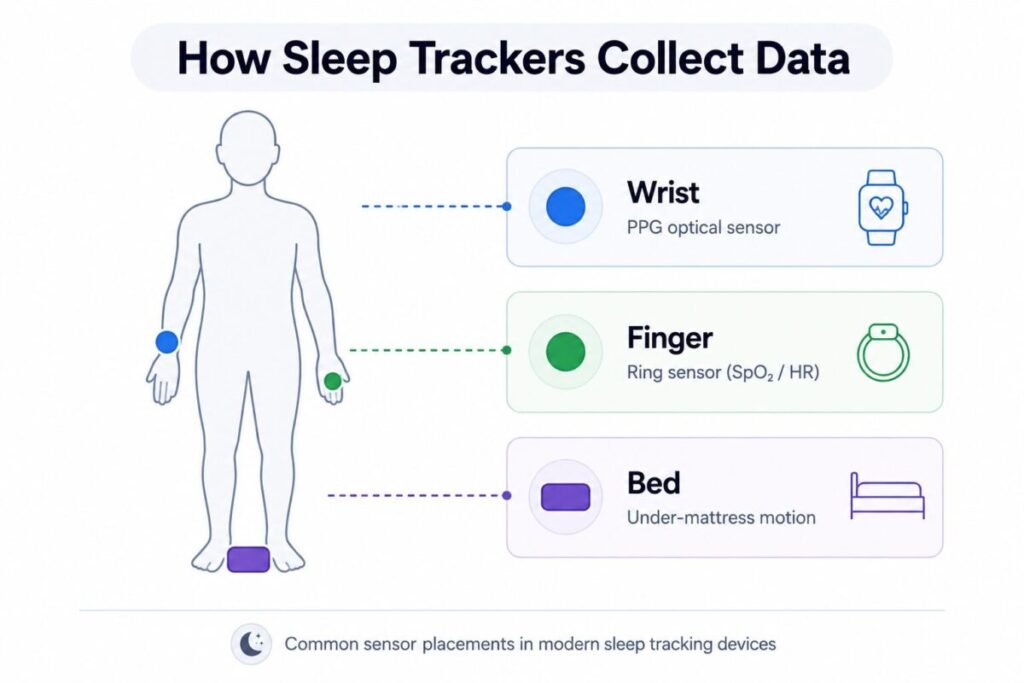
Here’s what actually matters.
Heart Rate Monitoring
Almost every wearable sleep tracker uses optical sensors called PPG sensors. They shine light into your skin and measure changes in blood flow. From that, they estimate heart rate.
At night, heart rate helps detect sleep stages and recovery trends. A lower resting heart rate usually signals better recovery. Sudden spikes may indicate stress, alcohol, illness, or poor sleep.
But here’s the reality: wrist-based heart rate tracking is not as accurate as a chest strap. It’s good for trends, not medical precision.
Who benefits most:
- Athletes tracking recovery
- People monitoring overnight stress patterns
If you just want basic sleep duration, this feature alone isn’t a deciding factor.
Blood Oxygen (SpO2) Tracking
SpO2 sensors estimate how much oxygen is circulating in your blood. During sleep, drops in oxygen levels may signal breathing irregularities.
Some devices market this heavily for sleep apnea detection. That’s misleading. A sleep tracker cannot diagnose sleep apnea. It can only flag unusual patterns.
So ask yourself: do you have breathing concerns? If yes, SpO2 may be useful as a screening signal. If not, it’s often just extra data.
Bottom line: helpful for awareness, not a medical tool.
ECG Monitoring
ECG measures electrical activity of the heart. A few smartwatches offer single‑lead ECG readings.
Important distinction: most consumer devices are cleared for detecting atrial fibrillation, not for improving sleep quality.
ECG does not directly improve sleep tracking. It’s a heart health feature that happens to be included in some sleep devices.
If your primary goal is better sleep, ECG should not be your deciding factor.
Stress Tracking and HRV
Heart rate variability, or HRV, measures the variation between heartbeats. Higher HRV usually signals better recovery and lower stress.
Many sleep trackers use overnight HRV to generate recovery scores.
This is one of the more meaningful features if you care about performance, burnout, or nervous system balance.
But again, trends matter more than single numbers.
Skin Temperature Tracking
Some devices track subtle changes in skin temperature overnight. These shifts can reflect illness, menstrual cycle changes, or circadian rhythm patterns.
For most users, this is secondary. For women tracking cycle patterns or people focused on long-term health insights, it becomes more valuable.
Movement Detection (Actigraphy)
At the core of sleep tracking is movement. If you’re still, the device assumes you’re asleep. If you move, it assumes you’re awake.
Sleep stages are estimated using movement plus heart rate data. They are not directly measured like in a clinical sleep lab.
This is important. Sleep trackers estimate. They do not measure brain waves.
If you understand that, your expectations stay realistic.
Sleep Stage Tracking and AI Analysis
Once sensors collect data, algorithms take over. This is where sleep tracker features start to look impressive. Devices promise REM detection, deep sleep breakdowns, recovery scores, and personalized insights.
Here’s what’s really happening.
Sleep Cycle Tracking
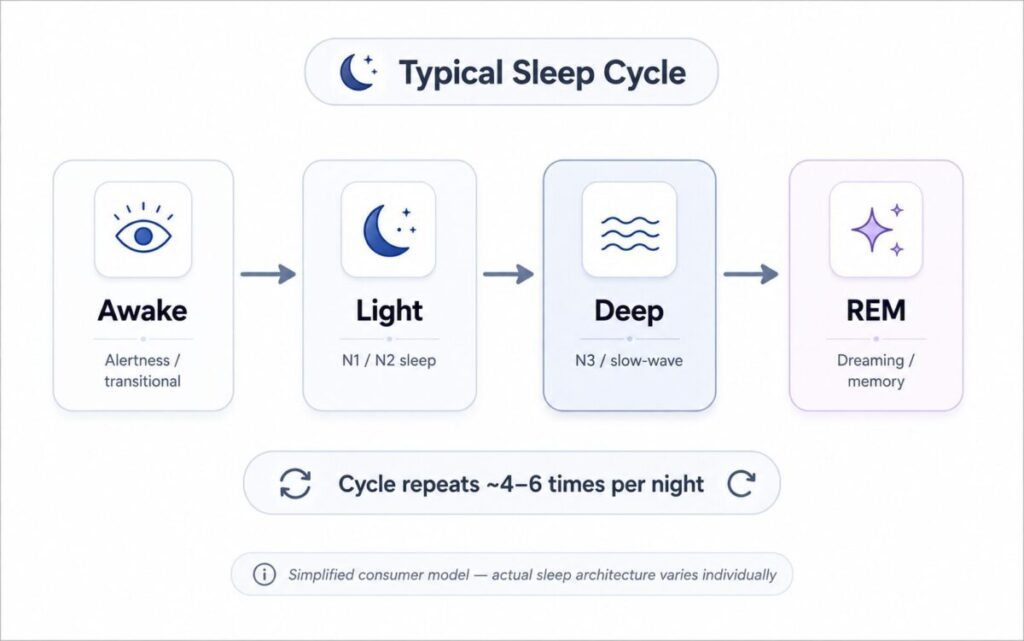
Most sleep trackers divide your night into light sleep, deep sleep, and REM sleep. They estimate these stages using movement, heart rate, and sometimes HRV patterns.
In a clinical sleep study, stages are measured using brain wave activity through polysomnography. Your wearable cannot read brain waves. It makes an educated guess based on patterns.
Does that make it useless? No.
For trends over time, stage estimates can be helpful. If your deep sleep consistently drops after late meals or alcohol, that pattern matters. The exact minute count is less important than the direction of change.
If you’re expecting lab-grade precision, you’ll be disappointed. If you want behavioral feedback, it works.
REM Detection
REM sleep is linked to memory consolidation and emotional regulation. Many devices highlight REM numbers as a major selling point.
But remember: REM is estimated, not directly measured.
Instead of obsessing over whether you got 82 minutes or 96 minutes, ask a better question. Are your REM trends stable? Do they drop during stress? Do they improve when your schedule stabilizes?
Use REM as a pattern signal, not a performance score.
Circadian Rhythm Insights
Some advanced sleep tracker features analyze your sleep timing and light exposure to estimate circadian rhythm alignment.
This can be genuinely useful for:
- Shift workers
- Frequent travelers
- People with irregular schedules
If you constantly feel tired despite “enough” sleep, circadian misalignment may be the issue.
Here’s the nuance: the tracker cannot fully measure your internal clock. It infers it based on behavior and sensor data. Still, even inferred data can guide better habits.
Daily Sleep Score
Sleep scores turn complex sleep data into a single number. That simplicity is appealing. It gives you a quick sense of how well you slept without digging through charts.
But here’s the part most people miss.
Each brand calculates sleep scores differently. Some prioritize total sleep time, while others weigh recovery metrics like HRV, deep sleep, or consistency. That means scores are not directly comparable across devices.
A score of 85 on one device might mean something completely different on another.
The real value comes from tracking your own trends.
If your score drops after late caffeine, heavy training, or poor sleep habits, that pattern is useful. It helps you connect behavior with outcomes. The absolute number matters less than the direction over time.
There’s also a downside.
Some users become too focused on the score itself. Instead of improving habits, they start chasing higher numbers. That can lead to frustration or even sleep anxiety, especially when the score doesn’t match how they feel.
Who this is for:
People who want a simple way to track sleep trends over time
When it helps:
When you use it to spot patterns and adjust habits
When it’s useless:
If you compare scores across devices or obsess over hitting a perfect number
Bottom line:
Sleep scores are useful as a trend tool, not a performance grade. Focus on consistency and patterns, not the number itself.
Sleep History and Trend Reports
This is where sleep trackers quietly become powerful.
Night-to-night data is noisy. Weekly and monthly trends tell the real story.
Consistent bedtime. Stable wake time. Reduced interruptions. These patterns matter more than single-night perfection.
If a device gives you long-term trend reports, that feature often matters more than flashy extras like ECG or WiFi connectivity.
Many people assume more data means better sleep. It doesn’t. Data without interpretation often creates anxiety. Sleep tracker features only matter when they guide real decisions instead of adding noise.
Smart Wake-Up and Alarm Features
Some sleep tracker features don’t just collect data. They change how you wake up. And that can have a real impact on how you feel in the morning.
Smart Alarms
Smart alarms aim to wake you during light sleep instead of deep sleep. The idea is simple. If you wake during a lighter stage, you feel less groggy.
Does it work?
For many people, yes. Especially if you struggle with morning brain fog. The device monitors movement and heart rate patterns, then triggers the alarm within a preset window.
If your main goal is smoother mornings rather than detailed analytics, this feature may matter more than REM breakdowns.
If you’re comparing devices, check whether smart alarms are available across all models or only premium versions. Many budget devices skip this. If affordability matters, you should cross-check this with our Affordable Sleep Trackers guide.
Silent Vibration Alarms
This one is underrated.
Instead of blasting noise into the room, the device vibrates on your wrist or finger. If you share a bed, this can be more valuable than any advanced sensor.
For couples, this is often the deciding feature. If that’s your situation, you may want to review Sleep Trackers for Couples before choosing a model.
Not every non‑wearable device offers this. Under‑mattress sensors usually rely on phone alarms. So if silent wake-up is important, wearable vs non‑wearable becomes a real decision point. You’ll see that comparison in our Non‑Wearable Sleep Trackers guide.
Haptic Feedback and Customizable Alerts
Some devices go beyond simple vibration. They offer adjustable intensity levels or progressive wake features.
If your schedule changes often, especially in healthcare, travel, or rotating shifts, smart alarm flexibility becomes more than a convenience. It becomes functional. You can compare how different devices handle this inside our Sleep Trackers for Shift Workers breakdown.
Many buyers obsess over advanced sensors like ECG or blood oxygen tracking. But if your real problem is waking up exhausted, smart alarm features will likely deliver more impact than additional health metrics. Solve the problem you actually have.
Coaching, Relaxation, and Mental Wellness Features
Some sleep tracker features focus less on measurement and more on behavior change. That’s important. Data alone does not improve sleep. Habits do.
AI Sleep Coaching
Many sleep trackers now offer some form of AI-driven coaching. They analyze your sleep patterns and suggest changes like going to bed earlier, reducing screen time, or keeping a consistent wake schedule.
Here’s the honest take.
The advice is rarely new. Most of it comes down to basic sleep hygiene. But structure changes how people respond to it. When suggestions are tied directly to your own data, they feel more relevant, and that makes you more likely to follow them.
That said, not all coaching systems are equal.
Some devices offer generic, repetitive tips that don’t evolve over time. Others, like Fitbit or Oura, adjust recommendations based on trends like sleep debt, recovery, or HRV. That difference matters if you actually plan to use the feature long term.
There’s also a limit to what coaching can do. It can guide habits, but it cannot diagnose or treat sleep disorders. If your sleep issues are more serious, this feature alone won’t solve them.
Who this is for:
Beginners who want guidance instead of interpreting raw sleep data
When it helps:
When you actively follow the suggestions and track changes over time
When it’s useless:
If you already understand sleep fundamentals or tend to ignore app feedback
Bottom line:
Sleep coaching is not about giving you new information. It’s about making you act on what you already know. Its value depends entirely on whether you follow through.
For beginners, I’d recommend comparing this feature inside our Best Sleep Trackers guide, since coaching quality varies widely by brand.
Guided Breathing and Wind‑Down Programs
Most sleep trackers now include guided breathing sessions or simple wind down routines inside their apps. On paper, this sounds useful. In reality, it depends on how you use it.
These features do not improve sleep tracking accuracy. They are not measuring anything new. Their only job is to help you fall asleep faster.
For people dealing with stress at bedtime, this can make a noticeable difference within a few nights.
If your main problem is a busy mind at night, guided breathing can help slow things down. A short 5 to 10 minute session before bed often reduces sleep latency, which matters more than obsessing over perfect sleep stages.
But here’s the catch. Most users stop using these features after a few days. The reminders feel repetitive, and the exercises don’t change much. So the benefit only exists if you build a habit around it.
Some devices handle this better than others. Fitbit and Oura stand out because they connect breathing sessions with HRV and stress data, so you can actually see whether these routines are improving your recovery over time.
Who this is for:
People who struggle with stress, anxiety, or racing thoughts before bed
When it helps:
When used consistently as part of a nightly routine
When it’s useless:
If you ignore the app or expect it to work automatically
Bottom line:
Guided breathing is easy to ignore, but if you actually use it, it can reduce the time it takes to fall asleep more reliably than most “advanced” sleep metrics.
Meditation and Mindfulness Features
Many sleep trackers now include short meditation sessions or basic mindfulness programs inside their apps. Some offer built-in content, while others rely on integrations with apps like Calm or Headspace.
On paper, this sounds like a bonus feature. In practice, its value depends on what you actually need.
Here’s the real question to ask yourself.
Are you looking for insight, or are you looking for intervention?
Sleep tracking gives you data. Meditation features try to change your behavior.
If you struggle with insomnia, stress, or difficulty winding down at night, these tools can be more useful than sleep stage charts. A short guided session before bed can help reduce mental noise and make it easier to fall asleep.
But similar to guided breathing, there’s a pattern. Most users try these features for a few days, then stop. The content doesn’t change much, and without consistency, the benefits fade quickly.
Ecosystem also matters more than most people expect. If you already use Apple Health, Google Fit, or a dedicated meditation app, not all sleep trackers integrate well. Some feel disconnected, which makes the experience harder to stick with.
Who this is for:
People dealing with stress, insomnia, or difficulty relaxing before bed
When it helps:
When used consistently as part of a nightly routine, especially alongside sleep coaching or stress tracking
When it’s useless:
If you already use a separate meditation app and don’t want everything in one place
Bottom line:
Meditation and mindfulness features can improve how you fall asleep, but only if you actually use them. Otherwise, they quickly become another ignored tab inside the app.
In that case, you should review Sleep Trackers for Insomnia before making a final choice.
Sleep Improvement Tips and Daily Feedback
Many sleep trackers now provide daily summaries with small, actionable suggestions. Reduce caffeine intake. Adjust your bedtime. Extend your wind down routine.
Individually, these suggestions feel minor. Over time, they can add up to meaningful improvements if you actually follow them.
But there’s a tradeoff.
Too many alerts, reminders, and constant scoring can create pressure. Some users end up chasing perfect sleep numbers instead of building better habits. That shift can make the experience stressful rather than helpful.
This is especially relevant for older adults or anyone who prefers simplicity. Too much data can feel overwhelming, which makes it less likely they’ll stick with the device long term.
Another limitation is repetition. Many apps repeat the same suggestions without adapting much, which reduces their usefulness after the first few weeks.
Who this is for:
People who want simple, daily guidance without digging into detailed sleep data
When it helps:
When you apply the suggestions consistently over time
When it’s useless:
If you ignore notifications or feel stressed by constant feedback
Bottom line:
Sleep improvement tips can work, but only when they lead to action. Otherwise, they become background noise that’s easy to ignore.
Environmental and Sound Monitoring Features
Not all sleep problems start inside your body. Some start in your bedroom.
Light. Noise. Temperature. Snoring. These factors often disrupt sleep more than people realize.
Snore Detection
Some sleep trackers use microphones or motion analysis to detect snoring patterns.
Important clarification: they detect sound patterns. They do not diagnose sleep apnea.
If you suspect breathing interruptions, a tracker can flag patterns. It cannot replace a sleep study.
If snoring is your main issue, this feature matters more than advanced ECG monitoring. In that case, comparing options in Sleep Trackers for Sleep Apnea will give you a more focused shortlist.
Sleep Sound Recording
Certain devices record short audio clips when unusual sounds occur during the night.
Is this necessary? Not for most people.
But if you wake up tired and don’t know why, sound logs can reveal coughing, restlessness, or environmental noise. That insight can change behavior faster than sleep stage charts.
This feature is more relevant for couples. If one partner snores and the other suffers, vibration alerts plus sound tracking can be a strong combination. That’s covered in detail in Sleep Trackers for Couples.
Bedroom Environment Monitoring
Some non‑wearable devices track room temperature, light levels, and ambient noise.
This can be more actionable than REM percentages.
If your room temperature fluctuates or outside noise spikes at night, no amount of deep sleep optimization will fix that.
Smart Lighting Integration
Some devices connect with smart lighting systems. They dim lights before bedtime or simulate sunrise in the morning.
This isn’t essential for most people. But for those with irregular schedules or limited natural light exposure, automated lighting can support better circadian alignment.
Still, don’t overestimate automation. A consistent sleep schedule has far more impact than any lighting routine.
If your main disruption is environmental, focus on tools that monitor and stabilize the bedroom setup. If the issue is recovery, stress, or biological signals, core health sensors will matter more.
Connectivity and Smart Ecosystem Integration
Connectivity sounds boring compared to REM sleep or blood oxygen levels. But in practice, it often determines how useful your device actually is.
Here’s what matters.
Bluetooth vs WiFi Sync
Most wearable sleep trackers sync data to your phone via Bluetooth. Some also offer WiFi syncing.
The assumption is that WiFi is better. Not necessarily.
Bluetooth is enough for most users. It’s energy efficient and reliable. WiFi mainly matters if you want automatic syncing without opening the app.
Here’s the tradeoff: WiFi can reduce battery life. If long battery performance is a priority for you, compare this carefully with our Sleep Trackers With Long Battery Life guide before choosing a model.
More connectivity does not always mean better experience. It often means more power consumption.
App Integration
This is where ecosystem becomes critical.
Does the device sync with:
- Apple Health
- Google Fit
- Third‑party fitness platforms
If you already track workouts, heart rate, or recovery data elsewhere, integration prevents data silos.
Without integration, your sleep data lives in isolation. That limits its usefulness.
For fitness-focused users, especially athletes, integration matters more than meditation features. If that’s your situation, you should also review Sleep Trackers for Fitness Enthusiasts to see which platforms connect properly.
Smart Home Integration
Some sleep trackers connect with Alexa or Google Home. They may adjust lighting, thermostats, or routines.
This sounds impressive. But ask yourself something simple.
Are you actually going to automate your bedroom environment?
If yes, this feature adds convenience. If not, it becomes background noise.
For most users, core sleep tracking accuracy matters more than voice control.
Voice Control
Voice features allow you to start sleep mode, check sleep scores, or trigger relaxation routines verbally.
Is it necessary? No.
Is it convenient? Sometimes.
This is a comfort feature, not a sleep quality feature.
If you’re shopping for seniors, ease of use may matter more than advanced metrics. In that case, review Best Sleep Trackers for Seniors to see which devices prioritize simplicity over feature overload.
Connectivity features don’t improve sleep directly. They improve usability. And usability determines whether you’ll stick with the device long term.
A technically advanced tracker that’s frustrating to use usually ends up forgotten in a drawer.
Choose a system that fits the digital tools you already rely on. Rebuilding your entire ecosystem for one feature rarely makes sense.
Which Sleep Tracker Features Do You Actually Need?
By now you’ve seen the full landscape. Sensors. Algorithms. Smart alarms. Connectivity. Coaching tools.
Now comes the harder question.
What actually matters for you?
Let’s simplify this.
If You’re a Beginner
ECG isn’t essential. Advanced HRV charts aren’t either. Complex integrations rarely matter at this stage.
What actually matters is:
- Reliable sleep duration tracking
- Basic sleep stage estimates
- Smart alarm
- Clear, simple reports
Too much data at the beginning often creates confusion.
If You’re an Athlete or Performance-Focused
Your priority shifts.
Now HRV trends, resting heart rate, recovery scores, and long-term data consistency matter more.
Sleep stage breakdown is useful. Daily readiness metrics become more valuable.
Meditation apps? Not essential.
Smart home integration? Irrelevant.
Trend accuracy? Critical.
If recovery is your main concern, compare devices inside Sleep Trackers for Fitness Enthusiasts before choosing.
If You Struggle With Insomnia
Your problem isn’t data. It’s falling asleep or staying asleep.
In this case:
- Smart alarms matter
- Guided breathing helps
- Stress tracking can reveal patterns
- Environmental monitoring may uncover noise or light disruption
REM percentages alone won’t fix insomnia.
If that’s your situation, start with Sleep Trackers for Insomnia instead of chasing advanced medical-style features.
If You’re Concerned About Breathing or Sleep Apnea
Blood oxygen tracking can be useful for pattern awareness. Snore detection may provide clues.
But let’s be clear.
A sleep tracker cannot diagnose sleep apnea. Only a medical sleep study can.
Use wearable data as an early warning signal, not a diagnostic tool. If breathing irregularities are your concern, review Sleep Trackers for Sleep Apnea to compare the most relevant options.
If You’re Buying for Seniors
Simplicity beats complexity.
Large fonts. Clear reports. Reliable battery life. Comfortable design.
Advanced ECG charts often go unused. Too many alerts can create anxiety.
For older adults, battery reliability and ease of use usually matter more than feature density. That’s why we break down the best options inside Best Sleep Trackers for Seniors.
If You Travel Frequently or Have Irregular Schedules
Circadian rhythm tracking becomes more valuable when your routine changes often. Smart alarms and consistent sleep timing insights help stabilize your rest, especially when dealing with time zone shifts or late arrivals.
If you travel regularly, portability and battery life also become important. Compact devices that last several days per charge are more practical for flights and hotel stays. For a detailed comparison, explore our guide to sleep trackers for travel to see which models are best suited for trips.
Ultimately, the best device is not the one with the most features. It is the one that solves your specific sleep challenge with the least friction. More features can add complexity, and complexity often reduces consistency.
Match the device to your lifestyle rather than the marketing claims.
Wearable vs Non‑Wearable Sleep Tracker Features
At some point, the decision stops being about features and starts being about format.
Do you want to wear something on your body?
Or do you want something that works in the background?
This choice affects accuracy, comfort, battery life, and feature access.
Here’s a simplified comparison.
Feature Comparison Table
| Feature | Smartwatch | Smart Ring | Under‑Mattress Sensor |
|---|---|---|---|
| Heart Rate Monitoring | Yes | Yes | No |
| Blood Oxygen (SpO2) | Yes | Yes | No |
| ECG | Some models | No | No |
| Sleep Stage Estimates | Yes | Yes | Yes |
| Smart Alarm (Vibration) | Yes | Yes | Limited or No |
| Snore Detection | Limited | Limited | Yes |
| Environmental Monitoring | No | No | Yes |
| Battery Life | 1–7 days | 4–7 days | Plugged in |
| Portability for Travel | High | High | Low |
Now let’s interpret this.
Smartwatches
Smartwatches offer the widest feature range. Heart rate, SpO2, sometimes ECG, smart alarms, app integration.
But they require charging frequently. If you forget to charge it, you lose data.
They work well for:
- Fitness-focused users
- People who already wear a smartwatch daily
- Users who want all-in-one tracking
If battery life is your biggest concern, compare carefully inside Sleep Trackers With Long Battery Life before committing.
Smart Rings
Rings are discreet and comfortable for overnight wear. They often offer strong HRV and recovery tracking.
They don’t usually include ECG. Screen interaction is limited. Everything runs through the app.
They work well for:
- Minimalists
- People who dislike bulky wrist devices
- Users focused on recovery trends
Under‑Mattress or Bedside Sensors
These require no wearable device. You place them under the mattress or beside the bed.
They often excel at environmental tracking and snore detection. But they lack direct heart-based metrics like HRV or SpO2.
They work well for:
- People who dislike wearing devices at night
- Couples analyzing shared sleep disruption
- Users focused on environment rather than recovery
If you’re leaning this direction, review Non‑Wearable Sleep Trackers for a deeper breakdown.
Wearables generally perform better when it comes to biological metrics like heart rate, HRV, and blood oxygen.
Non‑wearable devices tend to provide stronger environmental context, such as room temperature, noise levels, or shared sleep disruption.
Neither format is universally better. The right choice depends on the problem you’re trying to solve.
Choose the one you’ll consistently use. Even the most advanced tracker is useless if it stays on your nightstand.
Common Myths About Sleep Tracker Features
Sleep technology is surrounded by confident marketing. Some of it is accurate. Some of it stretches the truth.
Let’s clear a few things up.
Myth 1: More Sensors Mean Better Accuracy
It sounds logical. More sensors. More data. Better results.
Not necessarily.
If the core heart rate sensor is mediocre, adding ECG or skin temperature won’t fix that. Accuracy depends more on sensor quality and algorithm calibration than on feature count.
Also, more data does not automatically mean more insight. If the app doesn’t interpret the data clearly, it becomes noise.
Here’s what matters: consistency and trend reliability over time.
Myth 2: Sleep Trackers Can Diagnose Sleep Apnea
Many devices advertise blood oxygen tracking and snore detection. That leads people to assume they can diagnose apnea.
They cannot.
They cannot diagnose medical conditions. At best, they can flag irregular patterns that may require further evaluation.
If breathing interruptions are a concern, treat wearable data as an early signal. Then speak to a healthcare professional. If you’re comparing devices for breathing awareness, our Sleep Trackers for Sleep Apnea guide breaks down realistic expectations.
Myth 3: REM Numbers Must Be Exact to Be Useful
People obsess over getting 1 hour and 37 minutes of REM sleep versus 1 hour and 52 minutes.
But remember how sleep stages are measured. Your wearable estimates stages using movement and heart rate patterns. It does not read brain waves.
The exact number matters less than direction over time.
If REM drops consistently after stress, alcohol, or travel, that pattern is useful. Chasing perfect minute-level precision is not.
Myth 4: A Higher Sleep Score Always Means Better Sleep
Sleep scores simplify complex data into one number. That’s convenient.
But each brand calculates scores differently. One may prioritize duration. Another may weight HRV more heavily.
Comparing scores across brands is meaningless. Comparing your own trend over time is useful.
If your score drops every time you sleep fewer than six hours, that tells you something actionable.
Myth 5: The Most Expensive Device Is Automatically the Best
Higher price often means more features, not necessarily better sleep outcomes.
If your problem is inconsistent bedtime, a premium device with ECG and smart home integration won’t solve that.
If your problem is poor recovery from training, then advanced HRV metrics might justify the cost.
This is why matching features to your specific goal matters more than buying the most advanced model available.
Sleep trackers don’t improve sleep by themselves. Behavior does. The device only provides feedback.
If the data doesn’t influence your habits, it changes nothing.
Choose a tool that encourages action, not fixation.
Frequently Asked Questions
Are sleep trackers accurate?
Sleep trackers are reasonably accurate for tracking sleep duration and long‑term trends. They are less accurate at measuring exact sleep stages because they estimate stages using movement and heart rate data rather than brain wave activity.
They are best used for pattern recognition, not minute‑by‑minute precision.
Can a sleep tracker detect sleep apnea?
No. Sleep trackers cannot diagnose sleep apnea.
Some devices monitor blood oxygen levels and snoring patterns, which may signal irregular breathing. However, only a clinical sleep study can diagnose sleep apnea.
If breathing disruptions are your concern, treat wearable data as an early indicator, not a medical conclusion.
What is the most important sleep tracker feature?
Sleep trackers are devices that monitor your sleep patterns, duration, and quality to help improve your sleep habits.
Do sleep trackers work without internet?
Most wearable sleep trackers do not require constant internet access to record data. They store data locally and sync to your phone later via Bluetooth.
However, app updates, cloud backups, and certain integrations may require internet access.
Is blood oxygen tracking necessary for better sleep?
Not for most people.
Blood oxygen tracking can help identify irregular breathing patterns, but it does not directly improve sleep quality. If you do not have breathing concerns, this feature is usually secondary.
Are smart alarms actually effective?
For many users, yes.
Smart alarms attempt to wake you during lighter stages of sleep within a preset window. While not perfect, they can reduce morning grogginess compared to fixed-time alarms.
Effectiveness varies by device and individual sleep patterns.
Should I choose a wearable or non‑wearable sleep tracker?
Wearables are better for tracking biological metrics like heart rate and HRV.
Non‑wearable devices are better for monitoring environmental factors like room noise and temperature.
The better choice depends on whether your sleep challenges are biological or environmental.
Conclusion
Sleep tracker features can look overwhelming at first. Heart rate monitoring, blood oxygen tracking, smart alarms, sleep scores, AI coaching. The list keeps expanding every year.
But features only matter when they solve a real problem.
If groggy mornings are the problem, prioritize smart alarms.
For recovery and performance, focus on HRV and heart rate trends.
When the bedroom environment is the issue, noise and temperature monitoring become more important.
Buying the device with the longest feature list rarely leads to better sleep. Buying the device that fits your habits and goals usually does.
Remember that sleep trackers estimate patterns. They do not replace medical testing, and they do not fix sleep on their own. They provide feedback. What you do with that feedback determines the outcome.
Before choosing a device, review the Best Sleep Trackers to compare overall performance, or explore options tailored to your needs such as Sleep Trackers With Long Battery Life or Best Sleep Trackers for Seniors.
Sleep improves when behavior improves. The right tracker simply makes that process easier.

A passionate tech blogger and the founder of Best Tech View, a dynamic platform dedicated to all things technology. With a keen interest in the tech, Ahmad strives to provide insightful and engaging content on the latest tech trends, and breakthroughs.

