


Sleep tracker sleep analysis gives you a detailed breakdown of how you sleep, but most people don’t really understand what the data means.
REM sleep, deep sleep, light sleep, sleep cycles. These metrics look precise, but they are based on estimates, not direct measurements.
Here’s what matters.
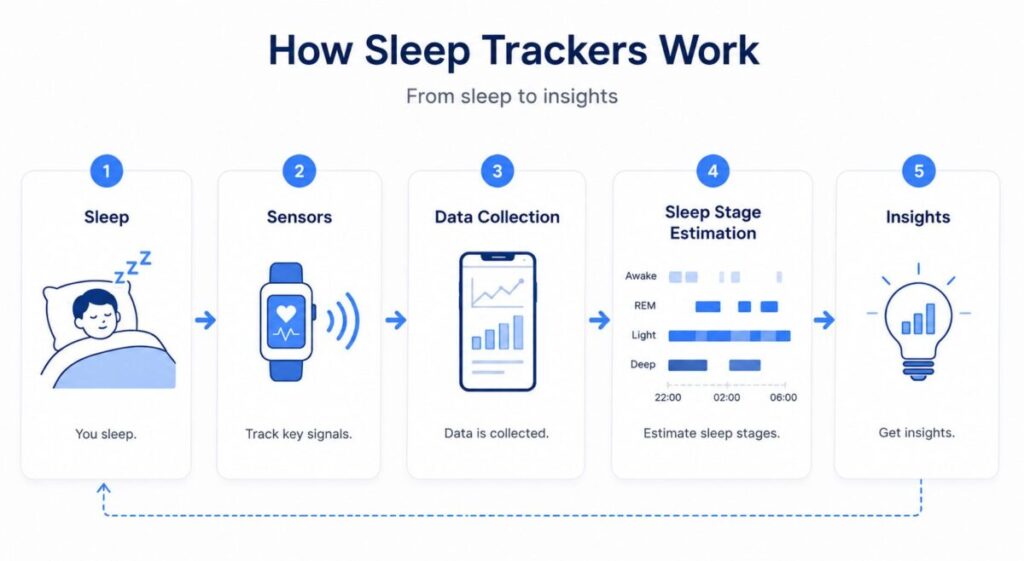
Sleep trackers don’t actually see your sleep stages. They use signals like movement, heart rate, and sometimes HRV to predict what your body is doing.
That doesn’t make the data useless. It just means you need to interpret it the right way.
In this guide, we’ll break down what sleep analysis metrics actually mean, how accurate they are, and which ones are worth paying attention to.
What Sleep Analysis Actually Measures
Sleep trackers make it look like they can precisely measure your sleep stages, but that’s not exactly how it works.
In reality, consumer devices do not directly measure brain activity, which is how sleep stages are identified in clinical sleep studies. Instead, they rely on indirect signals like movement, heart rate, and sometimes HRV to estimate your sleep stages.
This is the key difference.
Clinical sleep tracking uses EEG sensors to monitor brain waves. Sleep trackers use algorithms to predict sleep stages based on patterns in your body’s activity. That means the data is interpreted, not directly observed.
So when you see labels like REM, deep sleep, or light sleep, you’re looking at an estimate, not an exact measurement.
That doesn’t make the data useless.
It becomes valuable when you focus on patterns rather than precision. For example, consistent drops in deep sleep or irregular sleep cycles over time can signal changes in your habits, stress levels, or recovery.
The reason sleep data often feels confusing is because it looks more precise than it actually is. Numbers and charts create a sense of accuracy, but without context, they’re easy to misinterpret.
If you want to understand how these estimates connect with other signals like heart rate and recovery, our guide on sleep tracker features explains how the full system works.
The key takeaway:
Sleep analysis in trackers is about trends and patterns, not exact sleep stage accuracy.
Core Sleep Metrics Explained
Sleep trackers break your night into different metrics to help you understand how you sleep. The challenge is knowing what these numbers actually mean and which ones are worth paying attention to.
Sleep Cycles
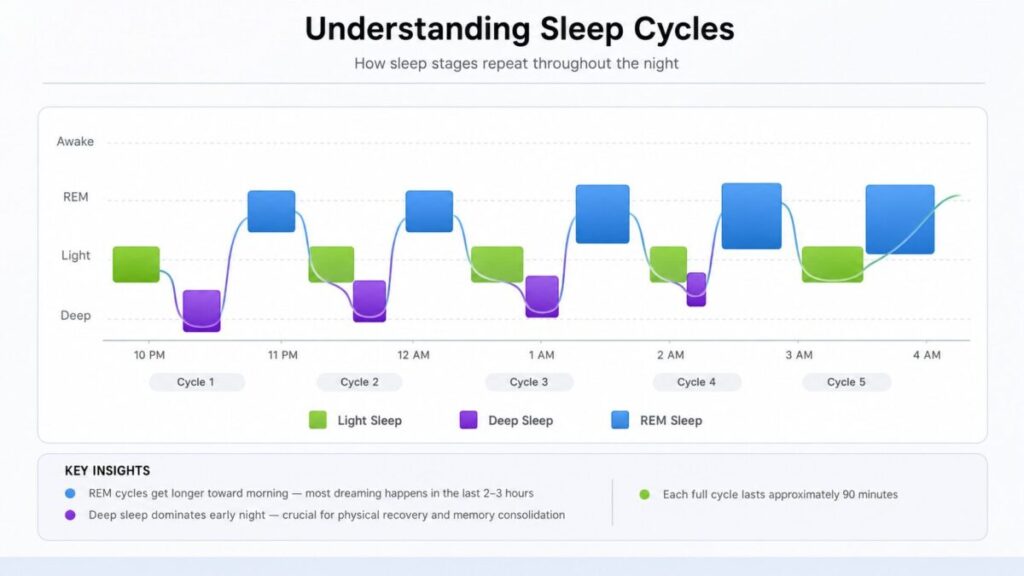
Sleep doesn’t happen in a straight line. It moves in cycles, usually lasting around 90 minutes and repeating several times throughout the night.
A typical cycle includes light sleep, deep sleep, and REM sleep. Instead of focusing on a single stage, it’s more useful to look at how consistently these cycles repeat.
Irregular or fragmented cycles can indicate poor sleep quality, even if your total sleep time looks fine.
REM Sleep
REM sleep is associated with dreaming, memory processing, and mental recovery. Most people focus on increasing REM, but that’s not always the right approach.
REM naturally increases later in the night, so cutting your sleep short often reduces REM more than anything else.
REM sleep is also closely linked to memory processing and brain function, as noted by the National Institute of Neurological Disorders and Stroke.
What matters most is consistency. If your REM sleep varies widely from night to night, it usually reflects irregular sleep patterns rather than a specific issue.
Light vs Deep Sleep
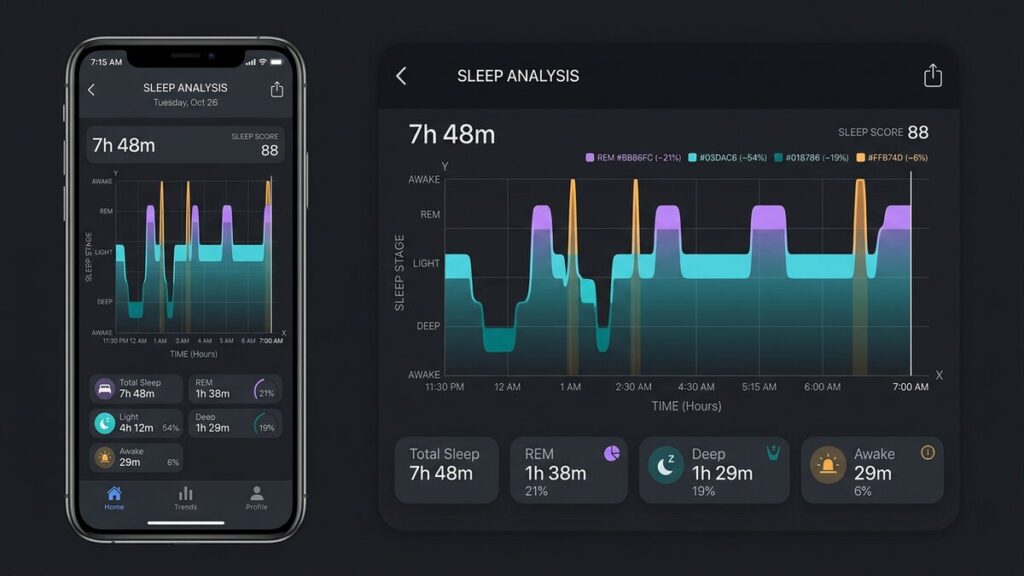
Light sleep makes up the largest portion of your night, while deep sleep is linked to physical recovery.
Many users try to maximize deep sleep, but this is where expectations often go wrong. Sleep trackers estimate deep sleep using indirect signals, so the numbers are not exact.
Instead of chasing higher deep sleep percentages, focus on whether your sleep feels consistent and restorative over time.
Body Movement Tracking
Movement is one of the primary signals used by sleep trackers. Frequent movement during the night can indicate restless sleep, discomfort, or interruptions.
Less movement usually suggests more stable sleep, but it’s not a perfect indicator. Some people naturally move more without it affecting sleep quality.
This is why movement data works best when combined with other metrics like heart rate and sleep cycles.
Circadian Rhythm
Circadian rhythm reflects your internal body clock. It influences when you feel sleepy, when you wake up, and how your body aligns with day and night cycles.
Sleep trackers estimate this based on your sleep timing and patterns over several days.
If your sleep schedule shifts frequently, your circadian rhythm can become misaligned, often leading to lower sleep quality and inconsistent energy levels.
If you want to see how these metrics connect with overall sleep quality, see our guide on sleep trackers for sleep quality.
The key takeaway:
Each metric tells part of the story. The real value comes from how they connect over time, not from any single number.
How Accurate Is Sleep Stage Tracking?
Sleep trackers present sleep stages like REM, deep sleep, and light sleep with precise-looking charts, but the accuracy behind those numbers is often misunderstood.
Here’s the reality.
Consumer sleep trackers do not measure brain activity directly, which is the standard used in clinical sleep studies like polysomnography, as explained by the Sleep Foundation. Instead, they estimate sleep stages using signals like movement, heart rate, and sometimes HRV.
That means the data is based on prediction, not direct measurement.
In controlled studies, most devices are reasonably accurate at detecting whether you are asleep or awake. But when it comes to distinguishing between specific sleep stages, accuracy drops.
Different brands also use different algorithms.
This means the same night of sleep can produce different results depending on the device you use, which is why comparing sleep stage data across devices rarely makes sense.
But this doesn’t make the data useless.
Sleep tracking becomes valuable when you focus on patterns over time. If your deep sleep consistently drops or your sleep cycles become irregular, that trend matters more than exact percentages from a single night.
It’s also important to match expectations with purpose.
If you’re looking for clinical-level accuracy, consumer sleep trackers will fall short. If your goal is to understand habits, recovery, and consistency, they can still provide useful insights.
For a broader look at how these metrics connect with other signals like heart rate and recovery, see our guide on sleep trackers for health monitoring.
What this means in practice:
Sleep stage tracking is directionally useful, not medically precise. Focus on trends, not exact numbers.
What Your Sleep Data Actually Tells You
Sleep data looks detailed, but its real value is simpler than most people think.
It doesn’t tell you exactly how well you slept in a clinical sense. It shows patterns in how your body behaves over time.
That distinction matters.
A single night of poor sleep doesn’t mean much. Sleep naturally varies from night to night, and short-term fluctuations are normal, according to the Sleep Foundation.
This is where sleep tracking becomes useful.
For example, you might notice that your sleep score drops after late caffeine, heavy meals, or inconsistent bedtimes. You might also see patterns where better routines lead to more stable sleep cycles and improved recovery.
That kind of feedback helps you connect habits with outcomes.
It’s also important to combine signals.
Sleep stages alone don’t tell the full story. When you look at sleep data alongside heart rate, HRV, and consistency, you get a clearer picture of what’s actually affecting your sleep. If you want to explore how these health signals work together, our sleep trackers for health monitoring guide breaks it down in detail.
At the same time, not all data needs action.
Small fluctuations are normal. Trying to “optimize” every number often leads to overthinking rather than better sleep. The goal is not perfect data, but better habits.
What to take from this:
Sleep data is most useful when it helps you spot patterns and adjust your behavior, not when you treat it as a precise score to optimize every night.
Which Sleep Metrics Actually Matter
Sleep trackers give you a lot of numbers, but only a few of them actually help you improve your sleep. The rest can easily distract you if you focus on them too much.
Here’s what matters in practice.
Sleep Duration and Consistency
Total sleep time is still the most important metric. If you’re not getting enough sleep, no amount of deep sleep or REM will make up for it.
Consistency matters just as much. Going to bed and waking up at the same time every day has a bigger impact on sleep quality than trying to optimize individual sleep stages.
Sleep Cycles
Sleep cycles are useful when you look at patterns over time. A stable rhythm of cycles usually indicates better sleep quality.
But focusing on how many cycles you had in a single night doesn’t tell you much. It’s the consistency of those cycles that matters.
REM and Deep Sleep
These are the most talked-about metrics, and also the most misunderstood.
Sleep trackers estimate REM and deep sleep, so the numbers are not exact. They also vary naturally from night to night.
Trying to increase deep sleep or REM directly often leads to overthinking. In most cases, improving your overall sleep habits will naturally improve these stages.
Movement and Restlessness
Movement is one of the more reliable signals. Frequent tossing, turning, or interruptions often reflect disrupted sleep, even if your sleep stage data looks fine.
This makes movement a useful indicator of sleep quality, especially when tracked over time.
The Bigger Picture
No single metric can explain your sleep on its own. The real value comes from combining sleep duration, consistency, movement, and recovery signals.
If you want to see how sleep data connects with health metrics like heart rate and HRV, our sleep trackers for health monitoring guide explains how these signals work together.
What matters most:
Focus on getting enough sleep, maintaining a consistent schedule, and tracking patterns over time. Treat detailed sleep stage data as supporting information, not the main goal.
Common Mistakes People Make
Sleep trackers can be helpful, but only if you use the data the right way. Many users misinterpret the numbers and end up focusing on the wrong things.
Here are the most common mistakes.
Chasing Perfect Sleep Scores
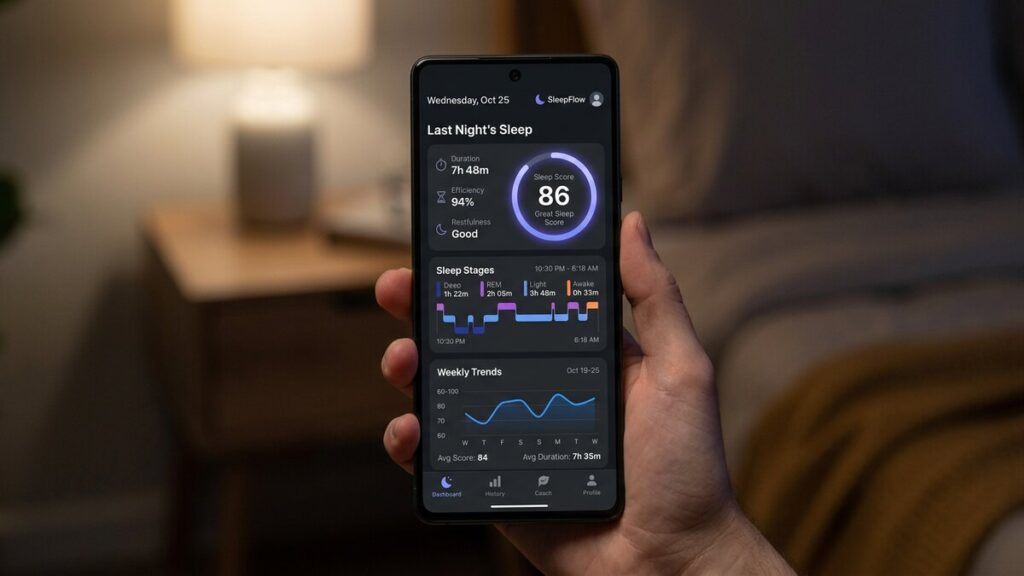
It’s easy to treat sleep scores like a performance metric, but that often leads to frustration. Sleep naturally varies from night to night, and trying to hit a perfect score can create unnecessary pressure.
Better sleep comes from consistent habits, not perfect numbers.
Obsessing Over Deep Sleep and REM
Many people focus too much on increasing deep sleep or REM. The problem is that these stages are estimates and can fluctuate naturally.
Trying to optimize them directly usually doesn’t work. Improving your overall routine has a bigger impact than chasing specific percentages.
Overanalyzing Single Nights
One bad night of sleep doesn’t mean something is wrong. Sleep is influenced by many factors, including stress, diet, and daily activity.
What matters is the pattern over time, not isolated results.
Comparing Data Across Devices
Different sleep trackers use different algorithms. That means the same night of sleep can produce different results depending on the device.
Comparing numbers across brands often creates confusion instead of clarity.
Ignoring Habits and Focusing Only on Data
Sleep data is only useful if it leads to changes in behavior. Looking at charts without adjusting habits like bedtime, caffeine intake, or screen use won’t improve your sleep.
If you want to focus on practical ways to improve sleep using data, our sleep trackers for sleep quality guide breaks down what actually works.
What to take from this:
Sleep trackers are tools, not scoreboards. The goal is to understand your habits and improve them, not to chase perfect data.
Best Sleep Trackers for Sleep Analysis
Not all sleep trackers are equally good at analyzing sleep data. Some focus on basic tracking, while others provide deeper insights into sleep cycles, recovery, and long-term patterns.
If sleep analysis is your priority, these devices stand out for different reasons.
Fitbit
Fitbit offers one of the most balanced sleep analysis experiences. It provides clear breakdowns of sleep stages, sleep score, and trends over time, all presented in an easy-to-understand format.
Best for:
Users who want simple, consistent insights without digging through complex data
Limitation:
Some advanced insights require a premium subscription
Apple Watch
Apple Watch focuses more on overall health but still delivers reliable sleep tracking when paired with its ecosystem. It provides sleep duration, trends, and integrates well with other health data.
Best for:
Users who want sleep data combined with broader health tracking
Limitation:
Battery life can limit consistent overnight tracking
Oura Ring
Oura is designed around sleep and recovery. It uses HRV, temperature, and sleep data to generate readiness insights rather than just raw numbers.
Best for:
Users who want a deeper interpretation of sleep and recovery trends
Limitation:
Less focus on detailed sleep stage breakdown compared to some competitors
Garmin Devices
Garmin devices are strong in combining sleep tracking with performance data. They provide detailed insights, especially for users who train regularly.
Best for:
Fitness-focused users who want to connect sleep with performance
Limitation:
The interface can feel complex for beginners
If you’re comparing these devices beyond just sleep analysis, including comfort, battery life, and health features, our full guide on best sleep trackers covers everything in detail.
What matters most:
The best device is not the one with the most data, but the one that helps you understand your sleep and act on it consistently.
Who Should Care About Sleep Analysis
Sleep analysis features are not equally useful for everyone. For some users, basic sleep tracking is enough. For others, understanding sleep patterns can make a real difference.
Here’s who benefits the most.
If you struggle with insomnia or poor sleep quality
Sleep analysis can help you identify patterns behind inconsistent sleep. Instead of guessing, you can see how factors like bedtime, stress, or daily habits affect your sleep over time.
For a more practical approach to improving sleep, see our guide on sleep trackers for sleep quality.
If you’re focused on fitness and recovery
Athletes and active individuals benefit from understanding how sleep affects recovery. Metrics like sleep cycles, HRV, and restlessness can help you adjust training intensity and recovery days.
You can explore more options in sleep trackers for fitness enthusiasts.
If you have an irregular schedule
Shift workers or people with inconsistent routines often experience disrupted sleep patterns. Sleep analysis helps track these patterns and adjust habits gradually.
If this applies to you, check out sleep trackers for shift workers.
If you want to build better sleep habits
Even if you don’t have a specific issue, sleep analysis can help you understand how your daily routine affects your sleep.
Over time, this makes it easier to build consistent habits that improve overall sleep quality.
What this means for you:
Sleep analysis is most useful when you have a clear goal. The more specific your need, the more valuable the data becomes.
Frequently Asked Questions
Are sleep trackers accurate for sleep stage analysis?
Sleep trackers are fairly accurate at detecting whether you are asleep or awake, but less accurate when it comes to specific sleep stages like REM or deep sleep. The data is best used for trends rather than exact measurements.
Can sleep trackers really measure REM and deep sleep?
They don’t measure sleep stages directly. Instead, they estimate REM and deep sleep using signals like movement and heart rate. This means the numbers are useful for patterns, not precision.
What is the most important sleep metric to track?
Sleep duration and consistency are the most important factors. Without enough total sleep and a stable schedule, other metrics like deep sleep or REM become less meaningful.
Why do different sleep trackers show different results?
Each device uses its own algorithm to estimate sleep stages. That’s why the same night of sleep can produce different results across different brands.
How should I use sleep data to improve my sleep?
Focus on patterns over time. Look for consistent changes related to habits like bedtime, caffeine, or stress, and adjust your routine accordingly.
Is it bad to check sleep data every day?
Not necessarily, but overchecking can lead to unnecessary stress. It’s usually more helpful to review trends over several days rather than focusing on daily fluctuations.
Do more detailed sleep metrics mean better sleep tracking?
Not always. More data doesn’t automatically improve your sleep. The value comes from understanding and using the information, not just collecting it.
Final Thoughts: What Your Sleep Data Really Means
Sleep trackers can give you a detailed view of your sleep, but the numbers only matter if you understand how to use them.
Sleep stages, cycles, and scores are helpful, but they are not exact measurements. Treat them as signals, not facts.
The real value comes from patterns.
When you track your sleep over time, you start to see how your habits affect your rest. Consistent schedules, better routines, and small adjustments often matter more than any single metric.
So don’t focus on perfect sleep data.
Focus on building habits that lead to better sleep, and use the data as a guide, not a goal.

A passionate tech blogger and the founder of Best Tech View, a dynamic platform dedicated to all things technology. With a keen interest in the tech, Ahmad strives to provide insightful and engaging content on the latest tech trends, and breakthroughs.

