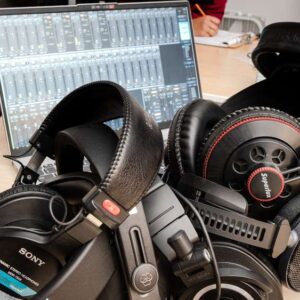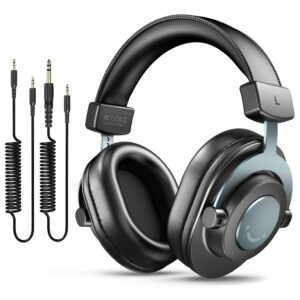


Mixing is not about excitement. It is about control. When searching for the best studio headphones for mixing and mastering, most people focus on brand names or dramatic sound signatures. What actually matters is accuracy.
In mixing, every decision affects balance, depth, and clarity. A headphone that exaggerates bass or boosts highs may feel impressive at first, but it can mislead you when shaping low‑end control or vocal presence. Mastering demands even greater precision, where subtle tonal imbalances and dynamic inconsistencies must be exposed, not masked.
You are not trying to make music sound impressive inside your headphones. You are trying to make decisions that translate across speakers, cars, phones, and everything in between.
Accuracy matters more than hype. A good mixing headphone reveals problems instead of flattering them. It should expose muddy low end, highlight harsh frequencies, and make imbalance obvious.
This guide explains what truly matters when choosing studio headphones for mixing and mastering, how different designs affect critical listening, and how to avoid the common mistakes that compromise translation.
Mixing vs Mastering: Why the Difference Matters
While mixing and mastering are part of the same production chain, the listening goals at each stage are not identical.
Mixing
During the mixing stage, the focus is on balance.
At this stage, you are adjusting:
- Relative levels between instruments
- Stereo placement and depth
- Frequency balance through EQ
- Dynamics through compression
A mixing headphone must provide accurate imaging and stable tonal balance. If the stereo field feels exaggerated or the low end is overemphasized, your decisions can shift in the wrong direction.
During mixing, clarity in the midrange is especially important. Vocals, guitars, and core elements live there. If the mids are recessed or masked, the entire mix can lose definition.
Mastering
Mastering focuses on refinement and translation.
At this stage, you are evaluating:
- Overall tonal consistency
- Micro‑dynamics
- Subtle compression artifacts
- Final stereo width and cohesion
Mastering requires even greater sensitivity to small changes. Slight high‑frequency harshness or low‑end imbalance becomes more noticeable.
Because of this, mastering engineers often prefer open‑back headphones with highly controlled tuning and strong detail retrieval.
Where They Overlap
Both mixing and mastering require:
- Neutral frequency response
- Low distortion
- Reliable stereo imaging
- Long‑session comfort
The difference lies in how critically you evaluate subtle details.
A headphone that works well for mixing can also work for mastering, provided it maintains control, transparency, and consistent translation across systems.
The key is not whether a headphone is labeled for mixing or mastering. The key is whether it presents the signal honestly.
What Makes a Headphone Good for Mixing?
There is no single spec that defines a great mixing headphone. It is a combination of behaviors that work together to give you a reliable reference.
Neutral Frequency Response
Neutral response is the foundation of reliable mixing.
A neutral headphone does not boost bass, scoop mids, or exaggerate treble. It aims to reproduce sound as evenly as possible across the frequency spectrum.
Why this matters:
- When bass is boosted, you will under-mix low frequencies
- If highs are exaggerated, you will reduce clarity in your mix
- Recessed mids weaken vocal and instrumental presence.
A flat or neutral response helps you make decisions that translate outside your headphones.
For a deeper explanation of how frequency response shapes monitoring accuracy, see our complete studio headphone features guide.
That said, no headphone is perfectly flat. The goal is not perfection. The goal is predictability.
Accurate Imaging and Stereo Separation
Imaging is your ability to place sounds in the stereo field. Left, right, center, and everything in between.
A good mixing headphone allows you to:
- Position instruments precisely
- Hear panning differences clearly
- Detect overlap and masking
Stereo separation plays a role here as well. If everything feels crowded or blurred together, you will struggle to build a clean mix.
This becomes critical in complex arrangements where multiple elements compete for space.
Controlled Bass Response
Bass is where most mixing mistakes happen.
A good mixing headphone should:
- Extend low enough to reveal sub-bass
- Stay tight and controlled
- Avoid artificial boost
If bass is loose or exaggerated:
- You may reduce low frequencies too much
- Your mix will sound thin on other systems
If bass is weak or rolled off:
- You may overcompensate
- Your mix becomes muddy elsewhere
You need bass that is extended enough to reveal problems, yet controlled enough to avoid misleading you.
Low‑frequency perception can vary depending on playback context, a principle explained in psychoacoustic research.
Low Distortion and Detail Retrieval
Distortion hides problems. Clean reproduction reveals them.
A quality mixing headphone should:
- Maintain clarity at different volumes
- Reveal subtle issues like clipping or noise
- Preserve micro-details in vocals and instruments
Detail retrieval is what allows you to catch:
- Background hiss
- Reverb tails
- Compression artifacts
These are the details that separate a rough mix from a polished one.
Long-Session Comfort
Mixing takes time. Sometimes hours at a stretch.
If your headphones are uncomfortable:
- You will take more breaks
- Your focus drops
- Your decisions become inconsistent
Look for:
- Even weight distribution
- Breathable ear pads
- Moderate clamping force
Comfort is not a luxury. It directly affects perception. Listening fatigue alters how you judge balance and dynamics.
Open Back vs Closed Back for Mixing
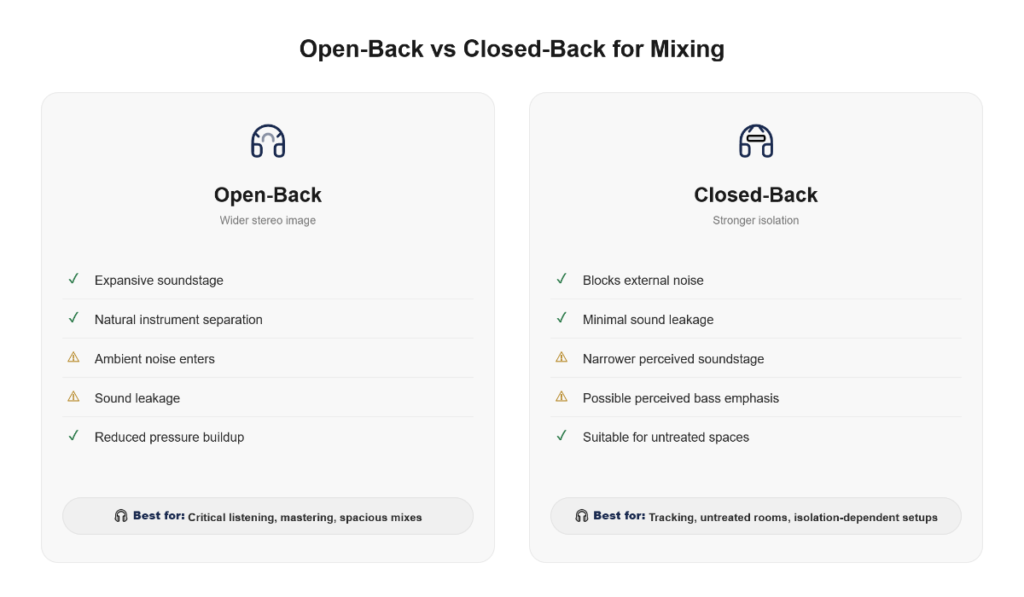
The choice between open‑back and closed‑back headphones directly influences how you perceive space, depth, and low‑frequency control during mixing.
Why Open‑Back Headphones Are Often Preferred
Open‑back headphones allow air to move freely through the ear cups. This reduces internal reflections and pressure buildup inside the enclosure, which can make the sound feel more open and spatially natural.
Common advantages include:
- Wider perceived soundstage
- More stable stereo imaging
- Reduced sense of enclosure or internal resonance
These traits are especially useful when making decisions about panning, depth, and instrument placement. A wider and more transparent presentation can make it easier to judge how elements sit within the stereo field.
In quiet rooms, many engineers prefer open‑back designs because they provide a more realistic sense of space.
For a deeper look at how open designs influence spatial perception, see our open‑back studio headphones guide.
When Closed‑Back Headphones Make Sense
Closed‑back headphones isolate sound by sealing the ear cups. This reduces leakage and blocks external noise.
Advantages include:
- Improved isolation from background noise
- Minimal sound bleed during recording
- Slightly stronger perceived low‑end presence
Closed‑back designs are useful when:
- You are working in a noisy environment
- You are recording and mixing in the same space
- External sound could influence your perception
For a focused breakdown of isolation‑oriented options, see our best closed‑back studio headphones guide.
The tradeoff is typically a narrower perceived soundstage and less airy spatial presentation. Internal reflections inside the sealed cup can subtly affect how space and depth are perceived.
Environment Matters More Than Category
There is no universal winner.
If your room is quiet and controlled, open‑back headphones often provide better spatial judgment. If you are dealing with background noise or shared spaces, closed‑back models become the more practical option.
The correct choice depends less on ideology and more on where and how you work.
Do You Need High Impedance Headphones for Mixing?
Impedance is one of the most misunderstood specifications in audio.
Many assume that higher impedance automatically means higher quality. In reality, impedance only describes how much electrical resistance a headphone presents to the amplifier.
Impedance vs Sensitivity
Impedance, measured in ohms, indicates how much voltage a headphone requires to reach a given listening level. Sensitivity determines how efficiently electrical power is converted into sound.
A high‑impedance headphone with low sensitivity may require substantial amplification. A lower‑impedance model with strong sensitivity may reach usable levels easily, even from modest sources.
Sound quality is influenced by the entire system, not impedance alone.
When Amplification Matters
If you use headphones in the 150Ω to 300Ω range, your source becomes critical.
On weak outputs, you may experience:
- Limited maximum volume
- Reduced dynamic headroom
- Softer low‑frequency control
With adequate amplification, these models often deliver more stable dynamics and improved clarity. The improvement does not come from impedance itself, but from proper electrical matching.
For many mixing setups using dedicated audio interfaces, high‑impedance headphones perform reliably. Without sufficient power, however, they can feel restrained.
Common Myths
Myth: High impedance headphones are always superior.
Reality: They can perform exceptionally well, but only when properly driven.
Myth: Low impedance equals low quality.
Reality: Many highly respected mixing headphones operate in the 32–80Ω range and deliver excellent accuracy.
The real question is not whether impedance is high or low. It is whether your amplification is appropriate for the headphone you are using.
Matching the headphone to the power source matters more than chasing a number on the spec sheet.
For a practical breakdown of how different devices handle amplification, see our studio headphones for PC, Mac and phones guide.
Best Studio Headphones for Mixing by Budget
The right mixing headphone depends on accuracy, not marketing position. The categories below reflect practical performance tiers rather than brand prestige.
Under $100
| Model | Design | Why It Works for Mixing |
|---|---|---|
| Audio‑Technica ATH‑M40x | Closed | Balanced tuning with controlled mids |
| Samson SR850 | Semi‑open | Wide stage for entry‑level mixing |
| Superlux HD681 | Semi‑open | Clear detail at a low cost |
These are functional tools for learning mixing fundamentals. They require careful reference checks against speakers, but they can teach balance and restraint effectively.
$100–300
| Model | Design | Why It Works for Mixing |
|---|---|---|
| Sennheiser HD 560S | Open | Neutral response with stable imaging |
| Beyerdynamic DT 770 Pro (80Ω) | Closed | Controlled low end and durable build |
| AKG K702 | Open | Expansive soundstage for spatial decisions |
For most engineers, this range offers the best balance between cost and performance. Tonal accuracy improves noticeably compared to entry‑level models, and imaging becomes more reliable for panning and depth control.
$300+
| Model | Design | Why It Works for Mixing |
|---|---|---|
| Beyerdynamic DT 1990 Pro | Open | High resolution and precise imaging |
| Sennheiser HD 600 / 650 | Open | Natural midrange and consistent balance |
| Audeze LCD‑2 | Planar | Controlled low end with detailed presentation |
High‑end headphones reveal micro‑details more clearly, particularly in complex arrangements. However, they often require strong amplification and a quiet environment to perform at their best.
For a broader comparison beyond mixing use cases, see our complete best studio headphones guide.
More resolution does not automatically produce better mixes. Discipline and reference checking still matter more than price.
Mixing on Headphones vs Studio Monitors
This comparison shapes how confidently your mixes translate.
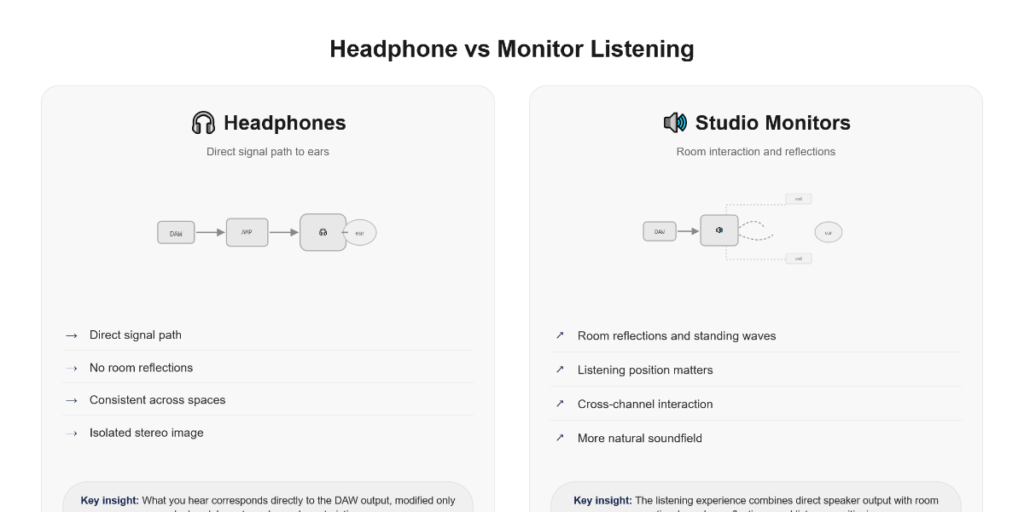
Headphones and studio monitors present sound in fundamentally different ways. For a deeper breakdown of this comparison, see our full studio headphones vs monitors guide. Neither is inherently superior. They reveal different aspects of a mix.
Advantages of Mixing on Headphones
Headphones remove the room from the equation.
There are no reflections from walls, no untreated bass buildup, and no acoustic coloration from your space. This can be especially useful if you work in a small or untreated room.
Other advantages include:
- Greater detail at lower listening levels
- Reduced the influence of room acoustics
- Portability and consistent playback across environments
Because you hear the signal directly in the ear, subtle noise, compression artifacts, and fine balance shifts can become more obvious.
Limitations of Headphone Mixing
However, headphones do not recreate how sound interacts with air and space.
Common limitations include:
- Lack of physical low‑frequency interaction
- Stereo presentation that can feel wider than speakers
- Difficulty judging how bass elements blend in a room
Headphones isolate the signal from physical space. That isolation changes perception. You are hearing separation, not interaction.
The Translation Problem
A mix that sounds balanced on headphones may not translate perfectly to speakers.
Typical translation issues include:
- Too much or too little bass
- Excessive stereo width
- Over‑compressed elements
- Reverb levels that feel exaggerated on speakers
This is not a flaw in headphones. It is a difference in playback context.
For reliable results, cross‑checking is essential. Alternate between headphones and speakers whenever possible. If monitors are not available, reference your mix on multiple playback systems.
Headphones are powerful tools. They are not complete environments.
Common Mistakes When Mixing with Headphones
Headphones are precise tools. That precision can be both an advantage and a trap.
Here are the most common mistakes engineers make when relying heavily on headphones for mixing.
Over‑EQing the Low End
Low frequencies are the easiest to misjudge.
If your headphones exaggerate bass, you may cut too much from the low end. If they roll off sub‑bass, you may boost excessively to compensate.
In both cases, the mix can translate poorly on speakers.
The goal is not to eliminate bass problems inside the headphones. It is to create balance that survives playback on multiple systems.
Over‑Compressing
Headphones reveal detail clearly, especially in the midrange.
That clarity can lead you to over‑process. You hear minor inconsistencies and try to “fix” them aggressively with compression.
The result is often a mix that feels controlled in isolation but lifeless on speakers.
Detail should inform decisions, not provoke overcorrection.
Mixing at High Volume
Louder monitoring changes perception.
At high volumes, bass and treble appear more prominent. This can mask balance problems and distort judgment.
Extended high‑volume sessions also cause fatigue, which reduces objectivity.
Lower monitoring levels tend to produce more consistent decisions over time.
Ignoring Crossfeed and Speaker Interaction
Headphones separate left and right channels completely. Speakers do not.
With speakers, each ear hears both channels with slight timing differences. That natural interaction affects how width and balance are perceived.
Crossfeed tools attempt to simulate that interaction. While not perfect, they can help approximate speaker behavior and improve stereo balance decisions.
Even without crossfeed, regularly checking your mix on speakers remains the most reliable safeguard.
Can You Mix Entirely on Headphones?
Yes, but only under certain conditions.
It is entirely possible to produce professional‑quality mixes using headphones alone. Many engineers work this way, especially in untreated rooms or mobile setups.
The difference is discipline.
Successful headphone‑only mixing usually depends on:
- Experience and familiarity with your specific headphones
- Consistent use of reference tracks
- Frequent cross‑checking on speakers or other playback systems
The limitation is not the headphone itself. It is perception.
Headphones isolate the signal from physical space. They do not reproduce how low frequencies interact with air or how stereo width collapses in a room. To compensate, you must develop awareness of how your headphones translate.
With time and consistent referencing, mixing entirely on headphones can be effective.
Without that discipline, translation problems become more likely.
Recommended Setup for Headphone Mixing
Headphone mixing becomes far more reliable when the signal chain is stable and intentional.
Audio Interface
A quality audio interface provides more than just connectivity.
It delivers:
- Clean digital‑to‑analog conversion
- Adequate amplification for your headphones
- Stable output levels across sessions
Weak onboard audio outputs actually cause many translation problems blamed on headphones. A consistent interface removes that variable and gives you a dependable reference point.
For device compatibility considerations, see our studio headphones for PC, Mac and phones guide.
Proper Gain Staging
Headphone accuracy begins with level discipline.
Set your monitoring and mix levels carefully:
- Avoid digital clipping at the source
- Maintain sufficient headroom
- Keep monitoring volume moderate
Excessive monitoring levels distort perception. Balanced gain staging preserves clarity and reduces fatigue over long sessions.
Reference Tracks
Reference tracks are one of the most powerful tools in headphone mixing.
Compare your mix against professionally mixed material in a similar genre. This helps you:
- Calibrate your perception of low end
- Evaluate stereo width
- Judge vocal presence and brightness
Reference listening reduces guesswork and anchors your decisions in reality.
Cross‑Checking
No single playback system tells the full story.
After completing a mix on headphones, test it on:
- Studio monitors
- Car audio systems
- Laptop or phone speakers
If the balance holds up across environments, your decisions are translating correctly.
Headphones can reveal detail. Cross‑checking confirms translation.
Frequently Asked Questions
Are open‑back headphones better for mixing?
In many quiet environments, yes.
Open‑back designs often provide a wider and more natural sense of space, which can improve stereo imaging and depth perception. However, they are less suitable in noisy environments due to sound leakage and limited isolation. The best choice depends on your workspace conditions.
Is a flat frequency response necessary for mixing?
Absolute flatness is not required. Consistency and neutrality are.
A balanced frequency response helps you avoid over‑compensating in the low or high end. The goal is not mathematical perfection, but predictable translation across playback systems.
Do I need an amplifier for mixing?
Only if your headphones demand more power than your source can provide.
Higher‑impedance or lower‑sensitivity headphones may benefit from dedicated amplification. If your interface can drive them comfortably without distortion or reduced headroom, an additional amp is not mandatory.
Can you master on headphones?
Yes, but it requires experience and careful cross‑checking.
Mastering relies on subtle tonal adjustments and spatial evaluation. Headphones can reveal detail, but they do not replicate how sound interacts with a room. Many engineers combine headphone monitoring with speaker reference to ensure reliable translation.
What impedance is best for mixing?
There is no universal ideal value.
Impedance should be matched to your amplification setup. Many mixing headphones operate effectively between 32Ω and 250Ω, depending on the power available from your interface or amplifier. Proper pairing matters more than the number itself.
Conclusion
The best studio headphones for mixing are not the most dramatic. They are the most dependable.
Instead of impressing you with exaggerated bass or sparkling highs, a reliable mixing headphone presents your mix clearly and consistently, even when that clarity exposes flaws.
Accuracy matters more than excitement in critical listening. What feels powerful inside headphones does not always translate outside them.
Your room, your signal chain, and your monitoring discipline all influence the final result. Headphones are one part of that system. They can reveal detail, but they cannot replace judgment.
Used intentionally, they become reliable reference tools. Used without awareness of their limits, they can distort perception.
The goal is not to chase perfect headphones.
The goal is to build a monitoring setup that helps your decisions translate across real‑world playback systems.

A passionate tech blogger and the founder of Best Tech View, a dynamic platform dedicated to all things technology. With a keen interest in the tech, Ahmad strives to provide insightful and engaging content on the latest tech trends, and breakthroughs.