

Choosing the best studio headphones by music genre is not as simple as picking a highly rated model and using it for everything. While many studio headphones claim to be versatile, different genres place very different demands on your monitoring setup.
For example:
- Rock music emphasizes midrange punch and vocal presence.
- Hip hop and bass-heavy genres depend on controlled sub-bass and low-end extension.
- Classical recordings require a wide soundstage and precise imaging.
- Jazz benefits from natural timbre and dynamic nuance.
- Electronic and EDM demand fast transient response and tight bass control.
If you’re producing, mixing, or recording in a home studio or professional environment, the wrong headphone tuning can quietly influence your decisions. What sounds exciting for one genre may create an imbalance in another.
Accurate monitoring plays a major role in preventing translation issues. As explained in Sound On Sound’s guide to monitoring basics, both headphone response and listening environment affect mix decisions.
If you are still comparing general options, you can explore our complete guide to the best studio headphones for a broader overview of top-rated models.
In this guide, we break down the best studio headphones for rock, hip hop, jazz, classical, EDM, acoustic music, and field recording, focusing on how frequency response, spatial presentation, and driver performance interact with different musical styles.
The goal is simple: help you choose studio headphones that support accurate mixing and production decisions for the genre you actually work in. If you are new to monitoring and want a broader overview, start with our complete guide to studio headphones to understand the fundamentals before choosing by genre.
Quick Comparison: Best Studio Headphones by Genre
| Genre | Best Overall | Budget Pick | Design | Best For |
|---|---|---|---|---|
| Rock | Sennheiser HD 650 | ATH-M50x | Open / Closed | Midrange clarity |
| Hip Hop | Audeze LCD-X | Sony MDR-7506 | Open / Closed | Sub-bass control |
| Classical | HD 800 S | AKG K702 | Open | Soundstage & imaging |
| Jazz | Focal Clear Mg | HD 600 | Open | Natural mids |
| EDM | LCD-X | ATH-M40x | Open / Closed | Transient speed |
| Acoustic | HD 600 | AKG K371 | Open / Closed | Transparency |
| Field | Sony MDR-7506 | ATH-M50x | Closed | Isolation |
Best Studio Headphones for Rock Music
What Defines Rock Monitoring
Rock mixes are dense, layered, and aggressive. Electric guitars, punchy kick drums, snare impact, and forward vocals all compete within a narrow frequency range.
That’s why midrange clarity is the single most important factor when choosing the best studio headphones for rock music.
In most rock productions, the emotional energy lives between 1 kHz and 4 kHz.
- If this region is underrepresented, guitars lose bite and vocals lose presence.
- If it is exaggerated, mixes become harsh and fatiguing.
For producers and mix engineers working in rock, accuracy in this range directly affects how your mix translates to speakers, car systems, and streaming platforms.
For more detailed recommendations focused specifically on accuracy, see our guide to the best studio headphones for professional mixing.
Ideal Sound Characteristics for Rock
The best studio headphones for rock should:
- Maintain clear, forward mids (1–4 kHz)
- Keep treble controlled to prevent cymbal harshness
- Deliver tight, punchy low end without masking guitars
- Preserve vocal presence without sounding aggressive
Rock does not usually require exaggerated sub-bass. Instead, it demands impact and definition between kick drum and bass guitar.
If the midrange is recessed, the mix feels hollow.
If it is hyped, fatigue sets in quickly during long sessions.d impact and definition in the kick and bass guitar relationship.
Common Rock Mixing Problems with the Wrong Headphones
Using the wrong headphones for rock production can lead to:
- Harsh cymbals that become piercing on playback
- Muddy midrange buildup from the guitar masks
- Vocals that disappear or feel overly aggressive
- Overcompensated EQ moves due to inaccurate monitoring
A well balanced studio headphone reveals these issues early so you can make confident mix decisions.
Best Overall: Sennheiser HD 650
Sennheiser HD 650 Open-Back Studio Headphones
The Sennheiser HD 650 is widely considered one of the best studio headphones for rock mixing due to its accurate midrange and natural presentation.
Why it works for rock:
- Forward but controlled midrange so electric guitars, snare crack, and vocals sit exactly where they should
- Tight and natural low end so kick drums and bass guitars stay defined, not bloated
- Smooth upper treble so cymbals and distortion remain detailed without harshness
- Reliable mix translation across studio monitors, car systems, and consumer headphones
Rock mixes live and die in the midrange. The HD 650 is known for getting that region right. It does not artificially hype frequencies, which is exactly why many mixing engineers trust it for critical listening.
Its open-back design provides a realistic stereo image, helping you place guitars left and right while keeping vocals centered and focused.
Best for:
Professional mixing engineers and serious home studio producers who want reference-grade accuracy for rock production.
Sennheiser HD 650 Specifications
| Feature | Detail |
|---|---|
| Type | Open-back |
| Driver | Dynamic |
| Impedance | 300 Ohm |
| Best For | Rock mixing |
Best Budget Option: Audio-Technica ATH-M50x
Audio-Technica ATH-M50x Professional Studio Monitor Headphones
The ATH-M50x remains one of the most popular studio headphones in the US market for rock and general music production.
Why it works:
- Clear and present mids so guitars cut through without getting muddy
- Energetic but controlled sound that adds punch without completely misleading your mix decisions
- Strong isolation for tracking vocals or live instruments
The ATH-M50x is widely used for a reason. It is not perfectly flat, but it balances accuracy and excitement, which can actually benefit rock tracks that need aggression and impact.
The closed-back design also minimizes sound leakage, making it practical for recording sessions.
Best for:
Beginner producers, bedroom studios, and anyone tracking vocals or instruments on a budget.
Open-Back vs Closed-Back for Rock
For mixing rock in a quiet studio, open back studio headphones often provide:
- More natural spatial cues
- Wider soundstage
- Less ear fatigue during long sessions
Many engineers prefer open-back studio headphones for rock mixing because of their natural spatial presentation.
For tracking live instruments, closed back headphones offer better isolation and prevent bleed into microphones.
The right choice depends on whether you are recording, mixing, or doing both.
If you need a deeper breakdown of design differences, see our guide on open back vs closed back studio headphones.
Best Studio Headphones for Hip Hop and Bass-Heavy Music
Why Sub-Bass Translation Is Critical
Choosing the best studio headphones for hip hop production is less about exaggerated bass and more about accurate low-frequency translation.
Modern hip hop, trap, and bass-heavy music rely heavily on sub-bass energy. 808s, layered kicks, and low synths often occupy overlapping frequency zones. If your headphones blur these areas together, your mix decisions will not translate well to speakers, car systems, or club playback.
This is one of the biggest challenges producers face. What sounds powerful in headphones can feel weak on speakers or overly boomy on larger systems.
Low-Frequency Zones That Matter
| Frequency Range | Role in the Mix |
|---|---|
| 20–60 Hz | Sub-bass depth and rumble |
| 60–120 Hz | Kick drum punch and impact |
| 120–250 Hz | Warmth versus muddiness |
The best headphones for hip hop allow you to clearly separate these zones instead of blending them into one wall of low-end energy.
Ideal Sound Characteristics for Hip Hop
The best studio headphones for hip hop and bass-heavy music should:
- Provide deep sub-bass extension without distortion
- Maintain separation between kick drums and 808 bass lines
- Deliver tight low-end control instead of bloated emphasis
- Keep mids clear so vocals cut through heavy instrumentation
Strong bass does not mean uncontrolled bass. You should be able to hear compression changes, envelope shaping, and subtle distortion in low-frequency elements.
Common Mixing Mistakes with Bass-Boosted Headphones
Using consumer-style bass-boosted headphones often leads to under-mixing the low end. Because the headphones exaggerate sub-bass, producers compensate by reducing bass levels.
The result is a thin or weak track when played on neutral systems.
If low mids are not clearly defined, unwanted muddiness between 120 and 250 Hz can reduce clarity and perceived loudness during mastering.
The objective is not more bass.
The objective is controlled bass that translates consistently across playback systems.
Open-Back or Closed-Back for Hip Hop?
Closed-back studio headphones are often preferred for:
- Tracking vocals
- Beat production
- Recording sessions requiring isolation
They provide stronger perceived low-end impact and prevent bleed.
Open-back headphones can offer a more natural tonal balance during mixing, especially in treated rooms. However, they may feel lighter in sub-bass presentation.
The right choice depends on your workflow and monitoring environment.
Best Overall: Audeze LCD-X
Audeze LCD-X Planar Magnetic Open-Back Headphones
The Audeze LCD-X is widely considered one of the best studio headphones for hip hop production, especially for producers who need precise sub-bass accuracy and low-end separation.
Why it works for hip hop:
- Exceptional sub-bass extension down to the lowest audible frequencies
- Planar magnetic drivers that keep 808s tight and controlled
- Clear separation between kick drum punch and sustained bass notes
- Detailed mids that keep vocals present over heavy instrumentation
For producers working with layered 808s, distortion, and saturation, the LCD-X makes it easier to hear compression changes and envelope shaping in the low end.
Because it is open-back, it is best suited for mixing rather than tracking.
Best for:
Professional producers, mix engineers, and serious home studios focused on hip hop, trap, and bass-heavy music.
Best Closed-Back Option: Beyerdynamic DT 770 Pro 80 Ohm
Beyerdynamic DT 770 Pro Closed-Back Studio Headphones
If you need isolation for recording and beat production, the DT 770 Pro 80 Ohm is one of the most reliable closed-back studio headphones for hip hop.
Why it works:
- Deep and impactful low end without excessive distortion
- Clear upper mids that keep vocals intelligible
- Strong isolation for vocal tracking
- Comfortable for long production sessions
The bass is slightly elevated compared to neutral reference headphones, which many hip hop producers prefer during beat creation. At the same time, it remains controlled enough for serious mixing work.
Best for:
Producers recording vocals, working in untreated rooms, or needing isolation during sessions.
Best Budget Pick: Sony MDR-7506
Sony MDR-7506 Professional Studio Headphones
The Sony MDR-7506 remains one of the most affordable studio headphones trusted in professional environments across the United States.
Why it works:
- Tight and readable low end
- Strong midrange clarity for vocal-focused hip hop
- Lightweight and portable
- Excellent value for small home studios
While it does not deliver massive sub-bass like planar magnetic models, it provides honest low-frequency detail that helps prevent overcompensation during mixing.
Best for:
Beginner producers, bedroom studios, and creators building a budget-friendly setup.
Best Studio Headphones for Classical and Orchestral Music
Why Classical Monitoring Requires a Different Approach
Choosing the best studio headphones for classical music requires a very different approach compared to rock or hip hop production.
With orchestral recordings, you are evaluating more than tone. You are evaluating space, depth, imaging accuracy, and dynamic range. Classical music often moves from extremely quiet passages to powerful crescendos. If your headphones compress that contrast or narrow the stereo field, critical detail is lost.
For classical and orchestral work, realism and spatial accuracy matter more than impact.
Wide Soundstage and Precise Imaging
The best studio headphones for classical and orchestral music must reproduce:
- Accurate left to right positioning
- Clear depth between front and back instrument sections
- Separation across strings, brass, woodwinds, and percussion
- Natural decay and hall ambience
A well-designed headphone allows you to mentally place each section of the orchestra. Violins should not collapse into the same space as violas and cellos. Room reverb should feel dimensional rather than flattened.
Imaging accuracy directly affects panning decisions and perceived balance.alance.
The Role of Open-Back Headphones
Open-back studio headphones are often preferred for classical mixing and critical listening because they create a more natural sense of space.
They typically:
- Provide a wider soundstage
- Reduce internal ear cup reflections
- Deliver more realistic spatial presentation
Closed-back headphones may feel more confined in large orchestral arrangements. However, in untreated rooms or recording situations where isolation is required, closed-back models can still be practical.
Your choice should reflect your monitoring environment and workflow.
Dynamic Range and Tonal Balance
Classical recordings depend heavily on dynamic range. Headphones that exaggerate bass or treble can distort your perception of orchestral balance.
A neutral frequency response with clean mids and smooth highs preserves the natural timbre of acoustic instruments. A deeper understanding of how frequency bands affect perception can improve critical listening skills, as outlined in this guide to understanding frequency ranges in a mix.
If you want a deeper explanation of frequency response and driver behavior, see our guide on studio headphone features explained. String harmonics, brass brightness, and subtle room reflections must remain intact without harshness.
For classical and orchestral production, accuracy and spatial realism matter more than excitement.
Best Overall: Sennheiser HD 800 S
Sennheiser HD 800 S Open-Back Reference Headphones
The HD 800 S is widely regarded as one of the best open-back studio headphones for classical and orchestral monitoring.
Why it works for classical:
- Extremely wide and realistic soundstage
- Precise imaging across the stereo field
- Clean and transparent midrange
- Excellent micro-detail retrieval for room ambience
Its spatial presentation makes it easier to evaluate orchestral depth and instrument placement with confidence.
Best for:
Professional engineers, classical editors, and critical listening environments.
Best Value Option: AKG K702
AKG K702 Open-Back Studio Headphones
The AKG K702 offers impressive soundstage and imaging at a more accessible price point.
Why it works:
- Open and airy presentation
- Strong instrument separation
- Neutral midrange for acoustic timbre
- Comfortable for long editing sessions
While not as resolving as high-end reference models, it provides excellent spatial clarity for orchestral work.
Best for:
Home studio composers, students, and budget-conscious engineers.
Best Studio Headphones for Jazz
Why Jazz Monitoring Is Unforgiving
Choosing the best studio headphones for jazz requires precision and tonal honesty.
Jazz recordings are often minimal. That simplicity makes them unforgiving. There is little layering to mask tonal imbalance or poor imaging. Every instrument sits exposed in the mix.
Small tonal shifts that might go unnoticed in rock or electronic music become obvious in jazz.
Natural Midrange and Instrument Separation
The best studio headphones for jazz should:
- Preserve natural midrange tone
- Avoid artificial bass or treble boosts
- Keep instruments clearly separated
- Maintain smooth, fatigue-free highs
Jazz relies heavily on midrange accuracy. Saxophone, trumpet, piano, upright bass, and vocals all occupy critical mid frequencies. If this region is colored, the entire performance feels unnatural.
Instrument separation is equally important. Some engineers also compare studio headphones vs monitors to determine which setup offers better spatial accuracy for jazz mixing. Each player should occupy a clearly defined position in the stereo field without collapsing into other elements.
Micro Detail and Dynamic Nuance
Micro detail matters in jazz production and critical listening.
You should be able to hear:
- Subtle finger movements on strings
- Breath texture in vocals or wind instruments
- Brush strokes on snare drums
- Room ambience and natural decay
If these details are missing, the recording loses emotional depth and realism.
Jazz is about nuance. Your headphones must reveal subtle dynamics without exaggeration.
Best Overall: Focal Clear Mg
Focal Clear Mg Open-Back Reference Headphones
The Focal Clear Mg is highly regarded for its natural midrange and exceptional detail retrieval, making it one of the best studio headphones for jazz and acoustic music.
Why it works for jazz:
- Highly accurate and lifelike mids
- Excellent instrument separation
- Smooth treble without harshness
- Strong micro-detail resolution
It presents instruments with realism and clarity, helping you evaluate tone, phrasing, and spatial placement with confidence.
Best for:
Professional engineers, mastering work, and critical jazz listening.
Best Value Option: Sennheiser HD 600
Sennheiser HD 600 Open-Back Studio Headphones
The HD 600 remains a classic choice for neutral monitoring and midrange accuracy.
Why it works:
- Honest and balanced frequency response
- Natural vocal reproduction
- Clear separation in small ensemble recordings
- Comfortable for long sessions
It does not exaggerate bass or treble, which makes it ideal for evaluating tonal balance in jazz mixes.
Best for:
Home studios, musicians, and budget-conscious engineers.
Best Studio Headphones for Electronic and EDM
Why Speed and Transient Response Matter
Choosing the best studio headphones for EDM and electronic music production requires a focus on speed and precision.
EDM is driven by transients. Kick drums, claps, hi-hats, and percussive synth elements rely on fast attack and clean decay. If your headphones cannot respond quickly enough, rhythmic detail becomes blurred.
In electronic music, timing is everything. Much of that precision depends on transient response. Sweetwater offers a helpful explanation of what transients are and why they matter in modern music production.
Transient Response and Low-End Control
The best studio headphones for electronic and EDM should:
- Deliver fast attack and controlled decay
- Maintain tight, punchy bass without distortion
- Separate layered synths clearly
- Preserve clarity in high-frequency percussion
Electronic productions often stack multiple layers of drums, bass, and synth textures. Without good separation, these elements blend into a congested mix.
Transient accuracy ensures that kick drums hit with impact and that sidechain compression remains audible and controlled.
What Happens with Slow or Bass-Heavy Headphones
Using slow or overly bass-boosted headphones for EDM production can cause:
- Kick drums to lose definition
- Hi-hats and percussion to blur together
- Rhythmic precision to weaken
- Overcompensation in EQ and compression
Producers may think the mix sounds powerful in headphones, but on club systems it can feel muddy or uncontrolled.
Balancing Deep Bass and Control
Deep bass extension is important in EDM, especially in genres like house, techno, trap, and dubstep. However, extension without control creates problems.
You need to hear:
- How compression shapes the kick
- How sidechaining affects bass movement
- Subtle distortion in synth layers
- The relationship between sub-bass and mid-bass
The objective is not maximum bass. The objective is tight, readable bass that translates to club systems and large speakers.
Best Overall: Audeze LCD-X
Audeze LCD-X Planar Magnetic Open-Back Headphones
The LCD-X is widely respected among electronic music producers for its fast transient response and excellent low-end control.
Why it works for EDM:
- Planar magnetic drivers deliver an extremely fast response
- Deep but controlled sub-bass extension
- Clear separation between layered synth elements
- Excellent detail retrieval for compression and saturation
It allows producers to hear fine changes in dynamics and sidechain movement, which is critical in electronic music.
Best for:
Professional EDM producers and advanced home studios.
Best Closed-Back Option: Beyerdynamic DT 1770 Pro
Beyerdynamic DT 1770 Pro Closed-Back Studio Headphones
For producers who need isolation and strong bass impact, the DT 1770 Pro offers powerful performance without excessive low-end bloom.
Why it works:
- Punchy and controlled bass response
- Detailed treble for crisp hi-hats and percussion
- Strong isolation for untreated rooms
- Durable build for studio use
It combines energy with enough accuracy for serious mixing decisions.
Best for:
Producers working in untreated spaces or shared environments.
Best Budget Pick: Audio-Technica ATH-M40x
Audio-Technica ATH-M40x Professional Studio Headphones
The ATH-M40x offers a more neutral tuning than many consumer bass-heavy models, making it suitable for beginner EDM producers.
Why it works:
- Controlled low-end response
- Clear midrange for synth layering
- Affordable and widely available in the U.S.
- Reliable performance for small studios
Best for:
Entry-level producers building their first electronic music setup.
Best Studio Headphones for Acoustic and Folk
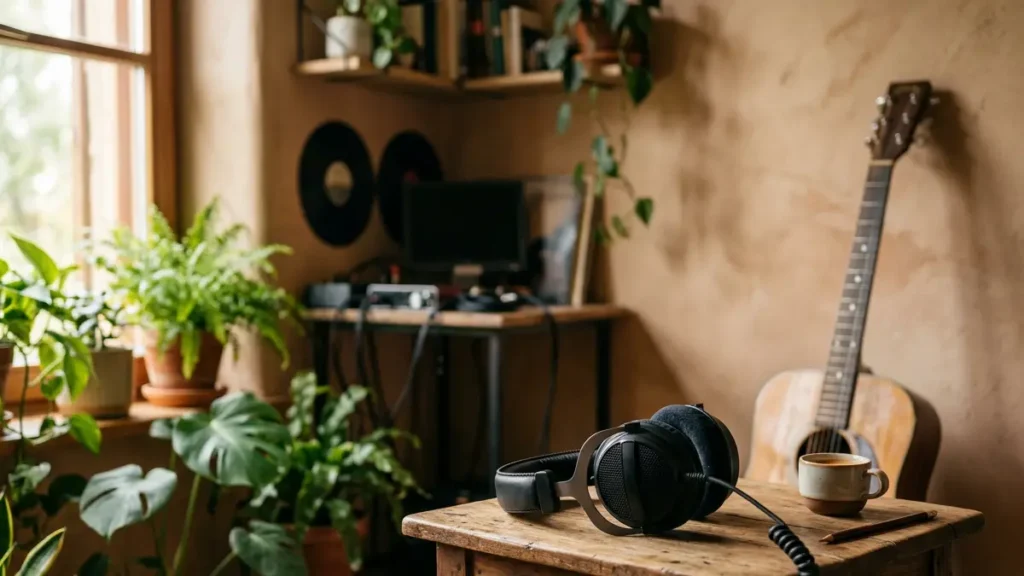
Why Accuracy Matters More Than Excitement
Choosing the best studio headphones for acoustic and folk music is about honesty, not enhancement.
Acoustic recordings rely on natural tone, dynamic expression, and subtle performance details. Unlike heavily processed genres, there is very little production masking. If your headphones add coloration, the authenticity of the recording suffers.
For acoustic music, transparency is more important than impact.
Detail and Transparency
The best studio headphones for acoustic music should reveal:
- String texture on acoustic guitars
- Finger movement and fret noise
- Vocal nuances and breath detail
- Subtle room reflections and ambience
Small tonal changes can dramatically affect how acoustic instruments feel. A slightly boosted treble can make guitars sound brittle. A recessed midrange can thin out vocals.
Accuracy in the midrange is especially critical because most acoustic instruments live there.
Common Problems with Colored Headphones
Using colored or bass-heavy headphones for folk and acoustic production can:
- Alter the natural tone of guitars and pianos
- Make vocals sound overly bright or recessed
- Hide fine performance details
- Lead to unnecessary EQ adjustments
If your monitoring exaggerates certain frequencies, you may compensate in the mix and unintentionally damage tonal balance.
Neutral tuning is usually the safest and most reliable choice for acoustic and folk work.
Best Overall: Sennheiser HD 600
Sennheiser HD 600 Open-Back Studio Headphones
The HD 600 is widely respected for its neutral frequency response and natural midrange, making it one of the best studio headphones for acoustic music.
Why it works:
- Honest and balanced tonal presentation
- Excellent midrange clarity for vocals and guitars
- Smooth treble without artificial brightness
- Comfortable for long recording or editing sessions
It presents acoustic instruments in a realistic and uncolored way, which is essential for folk and singer-songwriter production.
Best for:
Home studios, singer-songwriters, and mixing engineers working with acoustic arrangements.
Best Budget Option: AKG K371
AKG K371 Closed-Back Studio Headphones
The AKG K371 offers a relatively neutral tuning in a closed-back design, making it useful for recording and monitoring acoustic sessions.
Why it works:
- Balanced frequency response
- Clear and controlled bass
- Good isolation for tracking vocals
- Affordable for small studios
It is a practical choice for musicians recording in untreated rooms or shared environments.
Best for:
Bedroom studios and independent artists recording acoustic material.
Best Studio Headphones for Field Recording
Why Practical Performance Matters
Choosing the best studio headphones for field recording is very different from choosing headphones for mixing in a quiet studio.
Field recording rarely happens under ideal conditions. You may be working outdoors, in urban environments, on film sets, or in unpredictable acoustic spaces. In these situations, accuracy still matters, but control and reliability matter more.
Your headphones must help you monitor clearly in noisy surroundings without falling apart under constant transport.
Isolation and Durability
The best headphones for field recording should provide:
- Strong passive noise isolation
- Rugged and durable construction
- Consistent performance in loud or changing environments
- Comfortable fit for long sessions
Unlike open-back studio headphones, field recording models are almost always closed-back. Isolation allows you to hear mic placement, background noise, and unwanted artifacts even when external noise is present.
Durability is equally important. Headphones used on location are exposed to travel, weather changes, and frequent setup and teardown.
Essential Features for Field Work
When selecting studio headphones for field recording, look for:
- Closed-back design for isolation
- Detachable cables for easy replacement
- Replaceable ear pads and headband parts
- Foldable structure for portability
- Secure fit that stays stable during movement
Replaceable components are especially valuable for long-term use. Professional field recordists often rely on headphones for years, so serviceability matters.
Common Problems with the Wrong Headphones
Using open-back or fragile headphones in field environments can lead to:
- Poor monitoring due to external noise bleed
- Missed background noise issues
- Physical damage during transport
- Inconsistent monitoring when cables fail
For field work, practicality should take priority over wide soundstage or audiophile presentation. For more tracking-focused recommendations and studio-focused monitoring options, see our guide to the best studio headphones for recording.
Best Overall: Sony MDR-7506
Sony MDR-7506 Professional Closed-Back Headphones
The Sony MDR-7506 has long been trusted in broadcast, film, and field recording environments across the United States.
Why it works:
- Strong isolation for location monitoring
- Lightweight and foldable design
- Replaceable ear pads and detachable cable
- Clear and detailed sound for identifying noise issues
It allows you to hear handling noise, wind problems, and background interference clearly during recording.
Best for:
Field recordists, videographers, podcasters, and broadcast professionals.
Best Heavy-Duty Option: Audio-Technica ATH-M50x
Audio-Technica ATH-M50x Closed-Back Studio Headphones
The ATH-M50x offers solid durability and strong isolation, making it a reliable option for mobile recording setups.
Why it works:
- Durable construction
- Detachable cable options
- Good isolation in moderately noisy environments
- Comfortable for extended sessions
It balances portability with dependable performance.
Best for:
Content creators, documentary crews, and mobile audio engineers.
Do You Really Need Genre Specific Studio Headphones?
Let’s challenge the assumption.
Many producers search for the best studio headphones by music genre, assuming they need a different pair for rock, hip hop, jazz, or classical work.
The reality is more nuanced.
Genre-specific headphones can be helpful, but they are not essential for most users.
The Trade-Off
Different tunings emphasize different strengths. Here is a simplified comparison:
| Tuning Type | Strength | Weakness |
|---|---|---|
| Bass-heavy | Engaging for hip hop and EDM production | Can mislead low-end balance during mixing |
| Bright | Reveals detail and transients | Can cause listening fatigue and harsh mixes |
| Neutral | Accurate and reliable across genres | Less exciting for casual listening |
A headphone tuned for impact may feel impressive, but it can distort decision-making during critical mixing tasks.
When Genre-Specific Headphones Make Sense
Genre-specific studio headphones are most useful if:
- Professional delivery of client projects is your standard.
- Your focus stays heavily on one genre.
- Critical mixing or mastering demands your precision.
- You already own multiple monitoring references.
In professional environments, small tonal differences can influence mix translation across streaming platforms, broadcast systems, and commercial releases.
When a Balanced Headphone Is the Smarter Choice
For most home studio producers, musicians, and content creators in the U.S. market, a well-tuned neutral headphone is usually the better long-term investment.
A balanced studio headphone:
- Works across multiple genres
- Reduces the need for constant adaptation
- Improves mix consistency
- Saves money by avoiding multiple purchases
Instead of chasing genre-specific tuning, many engineers prefer accuracy and then make creative decisions intentionally.
How to Choose One Pair of Studio Headphones for Multiple Genres
If you do not want separate headphones for rock, hip hop, jazz, classical, and EDM, you can choose one well-balanced pair that performs reliably across genres.
Here is a practical step-by-step approach.
Step 1: Start with a Neutral Baseline
Look for:
- Balanced frequency response
- Slight warmth if preferred
- No extreme bass or treble boosts
- Clear and natural midrange
A neutral studio headphone gives you flexibility. Instead of being locked into a genre-specific sound, you can adjust creatively while maintaining accurate monitoring.
Step 2: Choose the Right Design
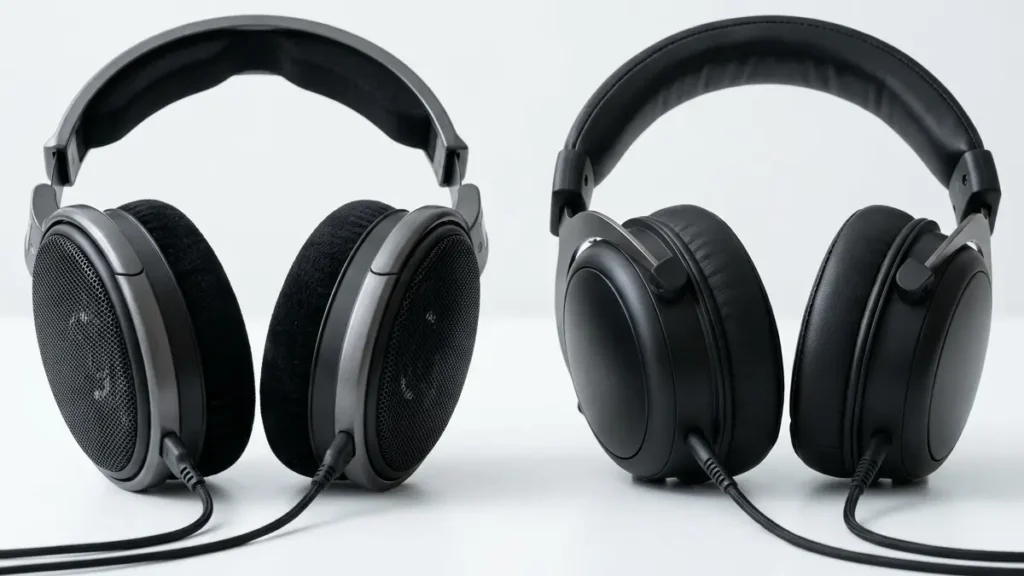
Your environment matters as much as sound tuning.
- Quiet environment: open-back headphones for natural soundstage and reduced fatigue
- Noisy room or recording setup: closed-back headphones for isolation and control
Open-back models are typically better for mixing. Closed-back models are more practical for tracking and untreated spaces.
You can explore detailed comparisons in our guides to open-back studio headphones and the best closed-back studio headphones.
Step 3: Match Your Workflow
Different use cases prioritize different features.
| Use Case | Priority Features |
|---|---|
| Mixing | Accuracy, detail, and stereo imaging |
| Recording | Isolation and low sound leakage |
| Production | Balanced tuning and long-term comfort |
| Hybrid workflow | Versatility across tasks |
If you both record and mix, a versatile closed-back or a neutral open-back paired with good room control may be the most efficient solution.
Step 4: Learn Your Headphones
This is where most people fail.
Even the best studio headphones for multiple genres require adaptation. The more you use them, the better your mix decisions become.
Spend time referencing:
- Professionally mixed tracks in your genre
- Your own previous projects
- Different playback systems such as speakers and car audio
Familiarity improves translation more than constantly switching gear.
Genre vs Frequency Focus Quick Reference
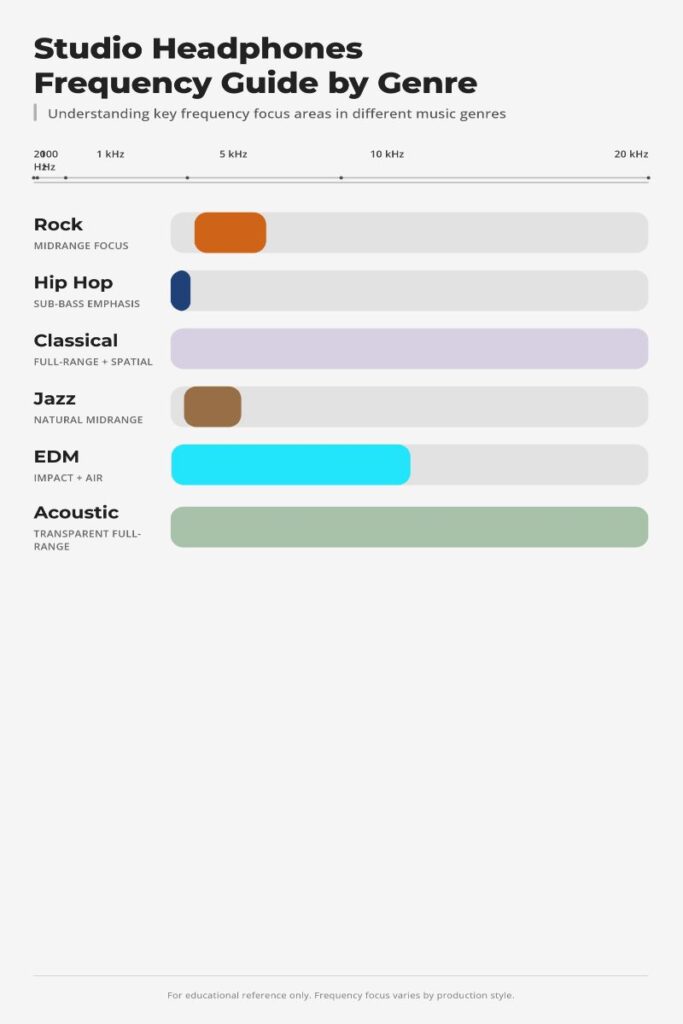
Here is a simplified guide to how different genres emphasize frequency regions:
| Genre | Key Frequency Focus |
|---|---|
| Rock | 1 kHz to 4 kHz midrange |
| Hip Hop | 20 Hz to 120 Hz bass |
| Classical | Full range with spatial cues |
| Jazz | 500 Hz to 3 kHz natural mids |
| EDM | 40 Hz to 10 kHz impact and air |
| Acoustic | Full-range tonal accuracy |
This table helps you understand what to listen for, even if you are using one neutral headphone for everything.
Frequently Asked Questions
Can one headphone handle all genres?
Yes, one well-tuned studio headphone can handle multiple genres, including rock, hip hop, jazz, classical, and EDM. However, it will not be perfectly optimized for each style.
A neutral studio headphone with balanced frequency response offers the best compromise. It allows you to make accurate mixing decisions without strongly favoring bass, mids, or treble.
For most home studio producers, one high-quality neutral pair is enough.
Are bass-heavy headphones good for hip hop production?
Bass-heavy headphones can make hip hop and EDM feel more exciting because they emphasize sub-bass and low-end impact.
However, boosted bass often leads to inaccurate mixing decisions. Producers may reduce low frequencies to compensate, resulting in thin mixes on neutral speakers.
For serious hip hop production, controlled and accurate bass is more important than exaggerated bass.
Why do my mixes sound different on speakers?
If your mixes sound different on speakers, car systems, or streaming playback, your headphones may be exaggerating or hiding certain frequencies.
Common causes include:
- Boosted bass that masks midrange detail
- Recessed mids that cause vocal imbalance
- Overly bright treble that leads to harsh mixes
Using more neutral studio headphones and referencing multiple playback systems improves translation.
Are open-back headphones always better for mixing?
Open-back headphones are often preferred for mixing because they provide a wider soundstage and more natural spatial presentation.
However, they are not ideal for recording or noisy environments because they leak sound and offer minimal isolation.
The best choice depends on your workflow. Open-back models are excellent for quiet mixing sessions, while closed-back headphones are better for tracking and untreated spaces.
Do professionals use multiple headphones?
Yes, many professional engineers use multiple headphones and monitoring systems.
This is not because one headphone is unusable, but because each model has strengths and limitations. Some may highlight midrange detail, while others reveal low-end issues.
By cross-checking mixes on different systems, professionals improve translation and reduce surprises during playback.
What is the most neutral studio headphone for all genres?
A neutral studio headphone has a balanced frequency response without strong bass or treble boosts. This type of tuning works best across multiple genres, including rock, hip hop, jazz, classical, and EDM.
Models like the Sennheiser HD 600 and Sennheiser HD 650 are widely regarded as neutral reference headphones. They provide accurate mids, controlled bass, and smooth highs, making them reliable for mixing and production across different styles of music.
For most users, a neutral headphone is the safest long-term investment.
Do I need different headphones for mixing and recording?
Not necessarily, but it depends on your workflow.
For mixing, open-back studio headphones are often preferred because they offer better spatial accuracy and a more natural soundstage.
For recording, closed-back headphones are usually better because they provide isolation and prevent sound leakage into microphones.
If you both record and mix, a high-quality closed-back headphone can handle both tasks. However, professionals often use separate pairs to optimize each stage of the process.
Conclusion
There is no single pair of studio headphones that is perfectly optimized for every genre. Rock demands midrange clarity. Hip hop and EDM require controlled sub-bass. Classical and jazz depend on spatial accuracy and natural tone. Acoustic music relies on transparency.
However, most producers do not need a separate headphone for each style.
If you work professionally in one genre and require maximum precision, choosing a headphone that complements that genre can improve efficiency and confidence during mixing.
For most home studios and hybrid workflows, a well-balanced, neutral studio headphone is the smarter long-term choice. It allows you to move between rock, hip hop, jazz, electronic, and acoustic projects without constantly adapting to extreme tuning differences.
The key is not hype. The key is translation.
Accurate monitoring helps your mixes sound consistent across speakers, cars, streaming platforms, and real-world playback systems. That consistency matters more than exaggerated bass or sparkling highs.
If you are unsure where to start, choose a neutral reference headphone from a trusted brand, learn its strengths and limits, and reference your mixes across multiple systems.
In the end, the best studio headphones for your music genre are the ones that help you make confident decisions and deliver mixes that translate reliably everywhere.

A passionate tech blogger and the founder of Best Tech View, a dynamic platform dedicated to all things technology. With a keen interest in the tech, Ahmad strives to provide insightful and engaging content on the latest tech trends, and breakthroughs.
